


Blue and white porcelain silver-colored pottery Kazuhiro Matsukawa
Blue and white porcelain silver-colored pottery Kazuhiro Matsukawa
Couldn't load pickup availability
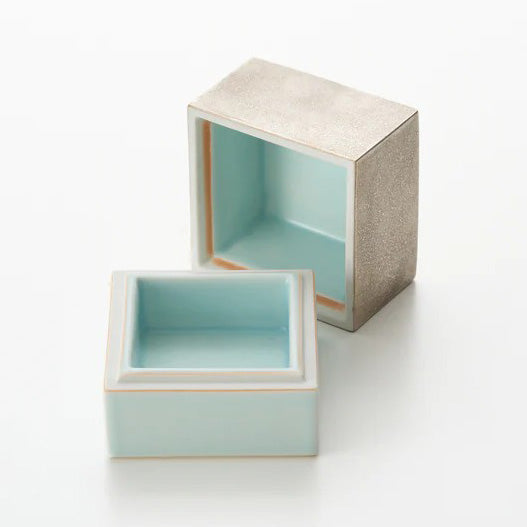
Blue and white porcelain silver-glazed ceramic box by Kazuhiro Matsukawa (φ: 8.1cm H: 8.1cm)
"Silver falls on the pale blue still water. When the lid is closed, it reveals the moon; when it is opened, it reveals water—a box that contains two layers of scenery."
Ⅰ Ceramic box: a vessel that changes its appearance when opened or closed
A ceramic box is not simply a container for storing something. By fitting the lid, you close the atmosphere, and by opening it, you release the atmosphere - the act of opening and closing is itself a small ritual that adjusts the density of the space .
This piece has a neat volume of φ8.1 x h8.1, and the expressions change clearly between the top (lid) and bottom (body). When closed, it is complete as a "complete landscape," and the moment it is opened, another world appears. This is a piece that most beautifully demonstrates the appeal of the box form.
II. Blue-and-white porcelain: "Clearer than white, softer than blue"
2-1 Pale blue porcelain surface: Designing light, not color
The blue-and-white porcelain body is not a uniform blue. It softly absorbs light, and the shadows change smoothly according to the slope of the surface, creating a subtle depth within the stillness .
Based on the purity of white porcelain, with a touch of pale blue, Kazuhiro Matsukawa's blue-and-white porcelain speaks more through the quality of its light than through its color. This restraint gives the box a dignity.
2-2 The "subtle temperature" seen in the joint line
A thin horizontal line appears at the boundary between the lid and the body. The pale orange color that peeks out there (a result of the firing process) injects a touch of human warmth into the ascetic world of pale blue porcelain. It is not completely pristine, but rather bears "modest" traces of the flame and the hand. The traces are just the right amount, not compromising the dignified purity.
III. Ginsai - The upper lid as a "skin that stores light"
3-1 Silver is not a mirror, but a speck of moonlight
The silver glaze that covers the lid of this piece does not have a flashy, metallic shine. As you can see from the photo, the surface has fine grains that catch the light in points and scatter it softly.
Its texture is similar to the cold, transparent brilliance of snow, frost, and moonlight. Because the silver is designed as a "skin that stores light," the box's appearance changes subtly depending on the angle from which it is viewed.
3-2 Two-layer structure: upper (silver) and lower (blue): Visual poetry
The lid is silver and the body is pale blue porcelain. The textures of the two materials overlap, creating a two-layered structure reminiscent of "heaven and water."
The silver glaze represents the "light above," and the pale blue porcelain represents the "clear surface of water." The closed vessel even evokes the serenity before the moon is reflected in the water. The smaller the vessel, the stronger this symbolism becomes, creating a clear tension in the space in which it is placed.
IV. The view inside – the “Pale Blue Room” that appears when opened
When you remove the lid, a pale blue space appears inside. The outside (silver glaze) collects light, while the inside (blue-white porcelain) quietly receives it.
Furthermore, the soft, subtle coloring of the firing process appears on the inside and corners, giving a slight sense of turbulence to the still waters within. This is not a flaw, but rather a breath of fresh air within the piece's perfection.
You can store incense, sugar candy, small seals, or tea ceremony accessories in it. Or, even leaving it empty and leaving it blank can be beautiful. A box can also be a vessel for storing empty space.
V. Combination - The cool brilliance of silver color for the tea ceremony season
This piece is well suited to the cold, transparent seasonal sensations of winter, the thin ice of early spring, and the clear night air of autumn. The silver glaze acts as the moon and frost, while the pale blue porcelain supports the scene as water and air.
Placing it on a black shelf or dark colored floorboard will highlight its contours, and combining it with white cloth or Japanese paper will enhance its purity.Among the tools, this box will not assert itself, but will act as the "center of the white space" and enhance the dignity of the entire space.
summary
The Blue and White Porcelain Silver-Glazed Ceramic Box is a tranquil and poetic piece that combines the clear silence of the blue and white porcelain with the sparkle of fine silver glitter. When closed, the silver clarifies the space like moonlight, and when opened, a pale blue space appears, and the scenery changes with every movement.
This piece seems to contain "light" and "water" in two layers, and will bring a dignified purity to both tea ceremonies and everyday life.
Biography
1977 Born in Kawachinagano, Osaka Prefecture
1998 Graduated from Nara College of Arts, Ceramic Art Course
2000 Graduated from Nara College of Arts
2001 Graduated from Kyoto Prefectural Pottery Technical College and studied under Takahiro Kondo
2006 Independent and opened a kiln in Kawachinagano City
Major solo exhibitions and exhibitions
2007 Kyoto Prefecture Fine Arts and Crafts New Artists Selection Exhibition (Kyoto Museum)
Two-person exhibition (Matsuzakaya Nagoya Art Gallery/Nagoya)
Solo exhibition (Kyoto Takashimaya Art and Craft Salon/Kyoto)
2008 Solo Exhibition (Campanule/Chiba)
Solo exhibition (Paramita Museum Small Gallery/Mie)
2009 Solo Exhibition (Gallery Espace/Nagoya)
2010 Solo Exhibition (Sapporo Mitsukoshi Art Gallery/Hokkaido)
Solo exhibition (Matsuzakaya Nagoya Art Gallery/Nagoya)
Solo exhibition (Alpark Tenmaya Art Gallery/Hiroshima)
2011 Solo Exhibition (Ceramics Gallery Furyo/Osaka) ('07)
2012 Solo Exhibition (Gallery Okumura/Tokyo) ('07 '09)
2013 Solo Exhibition (Lovely Hall 20th Anniversary Event/Osaka)
2014 Solo Exhibition (Tenmaya Hiroshima Hatchobori Art Gallery/Hiroshima) ('11)
2016 Solo Exhibition (Tenmaya Fukuyama Art Gallery/Hiroshima) ('08 '12)
Three-person exhibition (Hakata Hankyu Muse/Fukuoka)
2017 Solo Exhibition (Pinacotheca / Tokyo) ('14 '15)
Solo exhibition (Tenmaya Okayama Art Gallery/Okayama) ('08)
Solo exhibition (Atelier Hiro/Osaka)
2018 Solo Exhibition (Nihonbashi Mitsukoshi Main Store Art Gallery/Tokyo)
Solo exhibition (Takashimaya Osaka Gallery NEXT/Osaka) ('08 '11 '15)
2020 Solo Exhibition (Hana Asagi/Tokyo)
2021 Solo Exhibition (Gallery Tachibana/Nara) ('15 '17 '19)
2022 Two-person exhibition (Hana Asagi/Tokyo)
2023 Two-person exhibition (Atelier Hiro/Osaka)
2025 Two-person exhibition (Hana Asagi/Tokyo)
Solo exhibition (Midorigaoka Museum of Art/Nara)
Awards
36th Japan Traditional Crafts Kinki Exhibition (Osaka Prefecture Board of Education Award)
55th Japan Traditional Crafts Exhibition (Japan Crafts Association President's Award)
Public Collection
Midorigaoka Museum of Art
Share


-
[I will send it to you quickly and carefully]
We carefully package each product in a way that suits it best.
Also, delivery times vary depending on the piece (vessel, etc.).
Items that already come with a box will be shipped within 1-3 days of the order date.
For items that require a box to be made after your order, it will take approximately 30 days for production to be completed and then shipped.
In either case, once we have confirmed your order, we will contact you by email to inform you of the delivery date.
-
[Requests when purchasing pottery]
Even products that look the same may differ slightly in color, shape, size, etc.
The way the glaze is used, the power of the kiln, the firing method, the season, and the humidity also affect the appearance of the pottery.
Please understand the individuality of each piece of pottery and enjoy the unique warmth of handmade.