


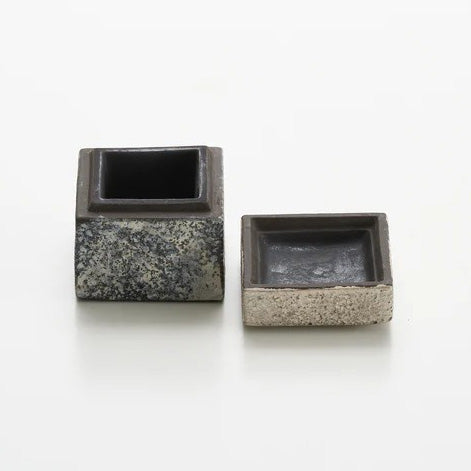
Black and white silver-colored ceramic box by Kazuhiro Matsukawa
Black and white silver-colored ceramic box by Kazuhiro Matsukawa
Couldn't load pickup availability
Black and white silver-painted ceramic box (Made by Kazuhiro Matsukawa, W5.2 x D5.2 x H5.2cm)
--"Black is silence, white is white space. Silver brings a moonlight-like presence to the border."
I. The "beauty of storage" of ceramic boxes: A vessel that is complete the moment the lid is closed
A ceramic box is not simply a container for storing small items. When the lid is opened, it becomes a vessel that welcomes the contents, and when closed, it becomes a form that maintains silence; each piece has two aspects. In the tea ceremony, it quietly supports the status of the utensils as a "universe in the palm of your hand," similar to an incense container or a small tea caddy.
This piece is based on a neat, square mass, but the seam lines of the lid are precisely aligned, and when closed, it exudes the "tension of being a box." The angles of the faces, the rising of the ridges, and the restraint of the glaze pooling are all concentrated within a small flat surface, creating a composition that naturally leads the eye to the "relationship between the surfaces."
II. Three layers of white, black, and silver - captivating not through contrast but through "temperature differences"
The "black and white" in the title is more than just a contrast of colors. The impression one gets from the photograph is that the white is placed as a place of quiet reflection rather than "brightness," and the black acts as a deep sinking rather than a heavy one. The inclusion of silver paint here prevents the boundary between black and white from being sharply cut off, but rather establishes a "blurred boundary" like pale moonlight.
Silver glaze changes its appearance over time. As it transitions from its initial clear brilliance to a more subdued antique color, the piece responds to the passage of time in daily life and the tea ceremony. Matsukawa Kazuhiro's silver glaze does not stand out with its flashiness, but rather plays the role of "raising the shadows and contours of the surface just one level more elegantly," giving a softness like breathing to the quiet tension between black and white.
III. The core of the design: The sense of touch created by the slight collapse of the cube
The appeal of this piece lies in the coexistence of its geometrical precision with the slight "wavering" of handmade pottery. It is not a perfect cube like an industrially produced product, but rather has slightly rounded corners and subtle undulations on the surface, which stimulate not only the visual sense but also the tactile sense. When held in the palm of your hand, you can certainly feel the temperature of the fired clay amid the tension of the rigid straight lines - this "sense of completion through touch" is the beauty of the ceramic box as a vessel.
The fit of the lid and the body also embodies the "beauty of the gap." Rather than sealing excessively tightly and making noise, they settle in and out quietly. It is in this gesture that the dignity of the tool is born. In the tea ceremony, the sound, speed, and even breathing of opening and closing a lidded container become part of the scenery, so this precision is directly connected to the "beauty of the gesture."
IV. What to include: incense, sugar candy, a seal, or something indescribable
Given its size, it would also be attractive for storing incense-making implements such as fragrant wood, incense paste, and incense pieces, or for konpeito sugar, small dried sweets, condiments, and salt. However, perhaps what ceramic boxes are truly suited to are "small, personal treasures" that don't have a specific purpose. A seal, a ring, a pebble from a trip, a short letter. When storing such items, the serenity of the black and white silver coloring gently protects the owner's time.
If used at a tea ceremony, it is most natural to think of it as an incense container. An incense container is not only a container for the incense itself, but also a container for the aura of the seasons. The silver light placed on the border between white and black evokes the lingering snow of spring, the moon at night, or the crisp air of winter, and does not fixate on the interpretation of the season. It is precisely because it does not impose an interpretation that the host's intentions and the guests' sensibilities come to life.
Ⅴ What the black and white and silver paint represent: not conflict, but the art of coexistence
Black and white are often spoken of as opposing concepts. However, rather than emphasizing their opposition, this piece allows the two to coexist in the same vessel, softening the boundary between them with the use of silver glaze. This is not a strong statement, but an expression of mature sensibility. Rejecting extravagance and loving silence, he still holds on to a single point of light (silver). The sense of clarity that Matsukawa Kazuhiro cultivated in his blue-and-white porcelain remains at the core of his work, even as he moves into the world of black and white.
Ⅵ Minor handling precautions (to cultivate beauty)
Ginsai changes to a more subdued color over time, but that is also its charm. After use, lightly wipe with a dry, soft cloth and avoid storing it in a humid environment for long periods of time to help maintain its appearance. This piece will be very appealing to those who see change as a "growing landscape" rather than "deterioration."
Biography
1977 Born in Kawachinagano, Osaka Prefecture
1998 Graduated from Nara College of Art and Design, Ceramic Art Course
2000 Graduated from Nara College of Arts
2001 Graduated from Kyoto Prefectural Pottery Technical College and studied under Takahiro Kondo
2006 Independent and opened a kiln in Kawachinagano City
Major solo exhibitions and exhibitions
2007 Kyoto Prefecture Fine Arts and Crafts New Artists Selection Exhibition (Kyoto Museum)
Two-person exhibition (Matsuzakaya Nagoya Art Gallery/Nagoya)
Solo exhibition (Kyoto Takashimaya Art and Craft Salon/Kyoto)
2008 Solo Exhibition (Campanule/Chiba)
Solo exhibition (Paramita Museum Small Gallery/Mie)
2009 Solo Exhibition (Gallery Espace/Nagoya)
2010 Solo Exhibition (Sapporo Mitsukoshi Art Gallery/Hokkaido)
Solo exhibition (Matsuzakaya Nagoya Art Gallery/Nagoya)
Solo exhibition (Alpark Tenmaya Art Gallery/Hiroshima)
2011 Solo Exhibition (Ceramics Gallery Furyo/Osaka) ('07)
2012 Solo Exhibition (Gallery Okumura/Tokyo) ('07 '09)
2013 Solo Exhibition (Lovely Hall 20th Anniversary Event/Osaka)
2014 Solo Exhibition (Tenmaya Hiroshima Hatchobori Art Gallery/Hiroshima) ('11)
2016 Solo Exhibition (Tenmaya Fukuyama Art Gallery/Hiroshima) ('08 '12)
Three-person exhibition (Hakata Hankyu Muse/Fukuoka)
2017 Solo Exhibition (Pinacotheca / Tokyo) ('14 '15)
Solo exhibition (Tenmaya Okayama Art Gallery/Okayama) ('08)
Solo exhibition (Atelier Hiro/Osaka)
2018 Solo Exhibition (Nihonbashi Mitsukoshi Main Store Art Gallery/Tokyo)
Solo exhibition (Takashimaya Osaka Gallery NEXT/Osaka) ('08 '11 '15)
2020 Solo Exhibition (Hana Asagi/Tokyo)
2021 Solo Exhibition (Gallery Tachibana/Nara) ('15 '17 '19)
2022 Two-person exhibition (Hana Asagi/Tokyo)
2023 Two-person exhibition (Atelier Hiro/Osaka)
2025 Two-person exhibition (Hana Asagi/Tokyo)
Solo exhibition (Midorigaoka Museum of Art/Nara)
Awards
36th Japan Traditional Crafts Kinki Exhibition (Osaka Prefecture Board of Education Award)
55th Japan Traditional Crafts Exhibition (Japan Crafts Association President's Award)
Public Collection
Midorigaoka Museum of Art
Share


-
[I will send it to you quickly and carefully]
We carefully package each product in a way that suits it best.
Also, delivery times vary depending on the piece (vessel, etc.).
Items that already come with a box will be shipped within 1-3 days of the order date.
For items that require a box to be made after your order, it will take approximately 30 days for production to be completed and then shipped.
In either case, once we have confirmed your order, we will contact you by email to inform you of the delivery date.
-
[Requests when purchasing pottery]
Even products that look the same may differ slightly in color, shape, size, etc.
The way the glaze is used, the power of the kiln, the firing method, the season, and the humidity also affect the appearance of the pottery.
Please understand the individuality of each piece of pottery and enjoy the unique warmth of handmade.