


Blue-and-white porcelain silver-sailed round goko Kazuhiro Matsukawa
Blue-and-white porcelain silver-sailed round goko Kazuhiro Matsukawa
Couldn't load pickup availability
Blue and white porcelain silver-colored round bowl by Kazuhiro Matsukawa
Φ7.5×h6.4
"The clarity of the pale blue porcelain is embraced, and the lingering beauty of the silver glaze protects it. A small universe that fits perfectly in the palm of your hand."
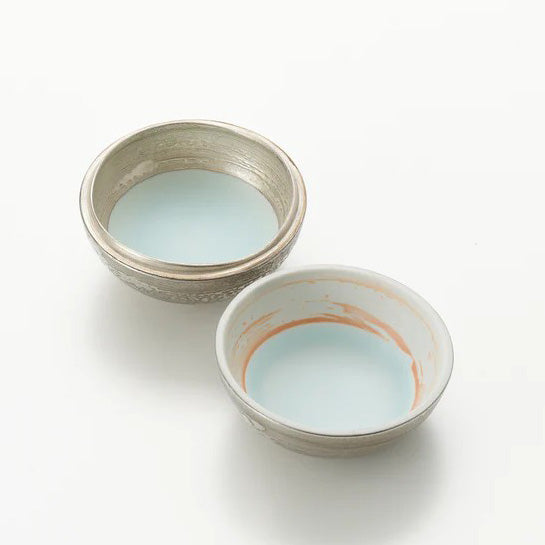
This work is a unique piece by Matsukawa Kazuhiro, combining the tranquility of pale blue porcelain with the touch of silver coloring in a round, spherical shape. The ridge where the lid and body meet appears like a "horizon" going around the center of the sphere, giving the impression of a layer of air hidden within, even when the vessel is closed.
I. The Maru-goko Form: "A vessel that protects" and "A vessel that creates space"
A gosu is a vessel with an inner world that has been used as an incense container for incense , kneaded incense, and pieces of fragrant wood, or as a small sweet dish or lidded container at tea ceremonies. The act of opening and closing it instantly changes the tempo of the space, regulating the guest's gaze and breathing.
Because this round bowl has no corners, your gaze is not drawn to any particular spot, and the moment you pick it up, your consciousness returns to the "center." The roundness when you pick it up, the feeling of your fingertips exploring as you turn the lid -- all of these elements naturally create the "space" that is so highly valued in the tea ceremony.
II. The expression of Ginsai: "sinking" the light rather than "reflecting" it
The outside is enveloped in the soft metallic light that is unique to Ginsai. However, it does not shine as brightly as a mirror, and as you can see in the photo, the silver surface is not uniform, but has a faded, hazy, and blurred appearance .
This expression does not make the vessel overly assertive, but rather absorbs the light and then gently lets it sink in. Rather than being a decoration for "gaiety," the silver glaze seems to function as a thin armor that gives the vessel dignity while maintaining serenity.
III. The inside of pale blue porcelain: Where the clear light blue color fits
Removing the lid reveals the pale blue-and-white porcelain glaze on the inside. Blue-and-white porcelain is less cold than white and less assertive than blue - its appeal lies in its clarity somewhere in between. This piece in particular creates a tranquil reflection like the surface of water when light falls on the vessel.
Furthermore, around the periphery, there are faint traces of scarlet, and in the stillness of the pale blue, there is a soft hint of fire and earth passing through. By not being completely colorless, but by incorporating a slight "warmth," the vessel is not abstract, but rather truly alive as pottery.
IV. The Wonders of Form: "Spheres," "Lines," and "Centers of Gravity"
A sphere is a tricky shape as even the slightest distortion can easily ruin the impression, but this piece has a firm roundness and a very neat line where the lid meets .
A small platform is provided at the bottom, so that the sphere does not float in the air, but rather its center of gravity settles at a single point . The tension that makes it seem as though it might roll around in the palm of your hand but doesn't is comfortable, and it combines stability as a tool with the poetry of its design.
V. Recommended Use (Tea Ceremony/Everyday Use)
As an incense holder : for storing kneaded incense, pieces of fragrant wood, small fragrances for incense smelling, etc. The opening and closing action is beautiful.
As a small sweet container : for small amounts of konpeito, amber sugar, or dried sweets. The silver-colored exterior elegantly accentuates the color of the sweets.
As a storage container : A place to store everyday important items such as rings, earrings, and small seals.
For seasonal decoration : Silver is compatible with the light of autumn and winter, while blue-and-white porcelain resonates with the light air of early spring. Another appealing feature is that it can be used all year round.
Ⅵ Key Points for Handling (Ginsai)
The appearance of the silver glaze may change if rubbed or polished too hard. Avoid using hard sponges or abrasive cleaners , and wipe gently with a soft cloth. We recommend storing the item in a place with low humidity. (Silver glaze may develop a more subdued appearance over time, and enjoying this change itself is one of the charms of silver glaze.)
The stillness of the sphere itself becomes the "silence of the vessel." Kazuhiro Matsukawa's blue-and-white porcelain makes the silence clear and transparent, and the silver glaze gives a faint echo to the outside of the silence.
It is beautiful even before it is opened, and becomes even more profound the moment it is opened. This Marugoko is a work that truly hones the essence of the goko form with a modern sensibility.
Biography
1977 Born in Kawachinagano, Osaka Prefecture
1998 Graduated from Nara College of Arts, Ceramic Art Course
2000 Graduated from Nara College of Arts
2001 Graduated from Kyoto Prefectural Pottery Technical College and studied under Takahiro Kondo
2006 Independent and opened a kiln in Kawachinagano City
Major solo exhibitions and exhibitions
2007 Kyoto Prefecture Fine Arts and Crafts New Artists Selection Exhibition (Kyoto Museum)
Two-person exhibition (Matsuzakaya Nagoya Art Gallery/Nagoya)
Solo exhibition (Kyoto Takashimaya Art and Craft Salon/Kyoto)
2008 Solo Exhibition (Campanule/Chiba)
Solo exhibition (Paramita Museum Small Gallery/Mie)
2009 Solo Exhibition (Gallery Espace/Nagoya)
2010 Solo Exhibition (Sapporo Mitsukoshi Art Gallery/Hokkaido)
Solo exhibition (Matsuzakaya Nagoya Art Gallery/Nagoya)
Solo exhibition (Alpark Tenmaya Art Gallery/Hiroshima)
2011 Solo Exhibition (Ceramics Gallery Furyo/Osaka) ('07)
2012 Solo Exhibition (Gallery Okumura/Tokyo) ('07 '09)
2013 Solo Exhibition (Lovely Hall 20th Anniversary Event/Osaka)
2014 Solo Exhibition (Tenmaya Hiroshima Hatchobori Art Gallery/Hiroshima) ('11)
2016 Solo Exhibition (Tenmaya Fukuyama Art Gallery/Hiroshima) ('08 '12)
Three-person exhibition (Hakata Hankyu Muse/Fukuoka)
2017 Solo Exhibition (Pinacotheca / Tokyo) ('14 '15)
Solo exhibition (Tenmaya Okayama Art Gallery/Okayama) ('08)
Solo exhibition (Atelier Hiro/Osaka)
2018 Solo Exhibition (Nihonbashi Mitsukoshi Main Store Art Gallery/Tokyo)
Solo exhibition (Takashimaya Osaka Gallery NEXT/Osaka) ('08 '11 '15)
2020 Solo Exhibition (Hana Asagi/Tokyo)
2021 Solo Exhibition (Gallery Tachibana/Nara) ('15 '17 '19)
2022 Two-person exhibition (Hana Asagi/Tokyo)
2023 Two-person exhibition (Atelier Hiro/Osaka)
2025 Two-person exhibition (Hana Asagi/Tokyo)
Solo exhibition (Midorigaoka Museum of Art/Nara)
Awards
36th Japan Traditional Crafts Kinki Exhibition (Osaka Prefecture Board of Education Award)
55th Japan Traditional Crafts Exhibition (Japan Crafts Association President's Award)
Public Collection
Midorigaoka Museum of Art
Share


-
[I will send it to you quickly and carefully]
We carefully package each product in a way that suits it best.
Also, delivery times vary depending on the piece (vessel, etc.).
Items that already come with a box will be shipped within 1-3 days of the order date.
For items that require a box to be made after your order, it will take approximately 30 days for production to be completed and then shipped.
In either case, once we have confirmed your order, we will contact you by email to inform you of the delivery date.
-
[Requests when purchasing pottery]
Even products that look the same may differ slightly in color, shape, size, etc.
The way the glaze is used, the power of the kiln, the firing method, the season, and the humidity also affect the appearance of the pottery.
Please understand the individuality of each piece of pottery and enjoy the unique warmth of handmade.