

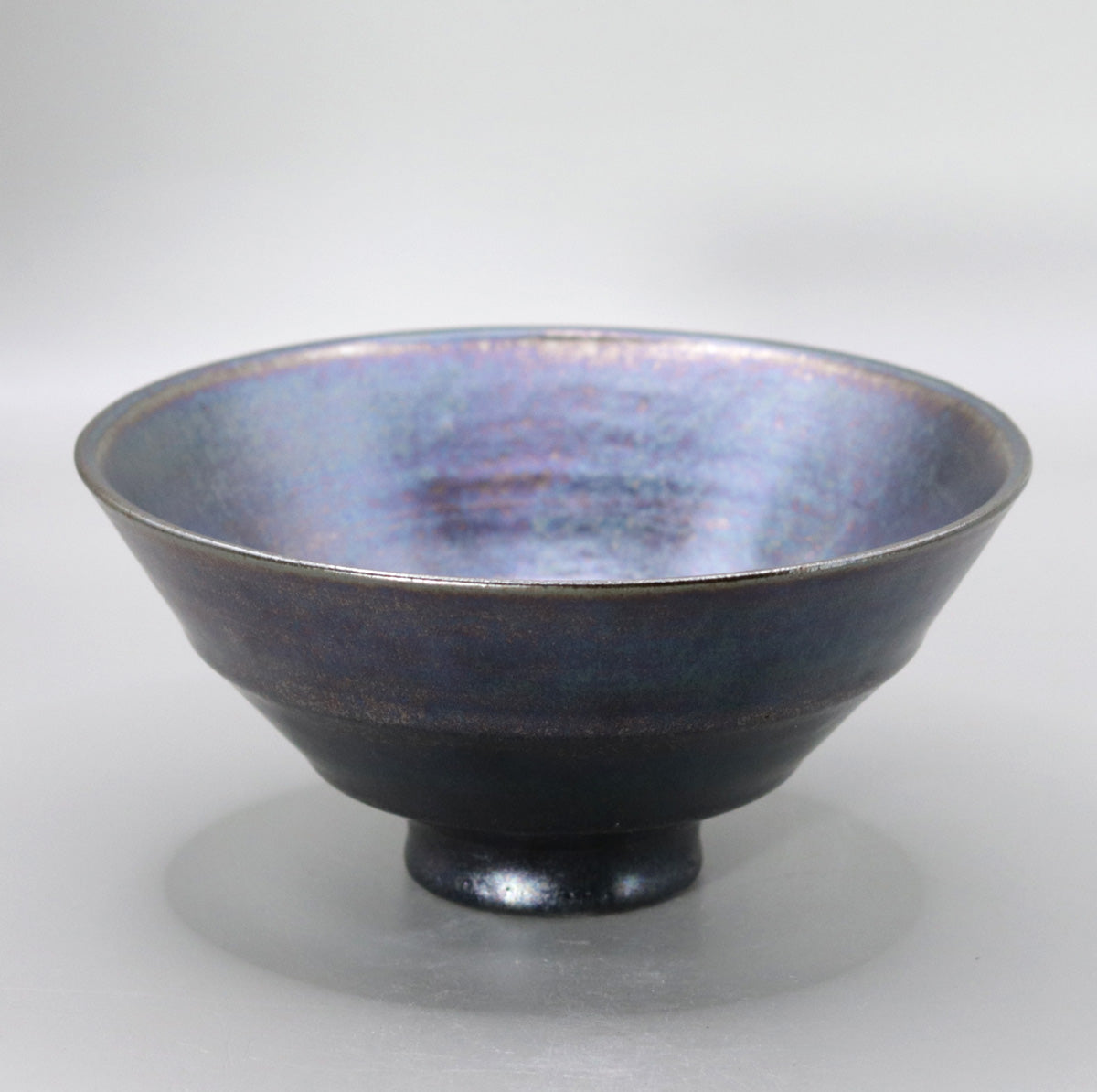
Iron glaze kiln-transformed tea bowl (line pattern) by Masaru Okada
Iron glaze kiln-transformed tea bowl (line pattern) by Masaru Okada
Couldn't load pickup availability
Width: 14.8cm Height: 7.0cm
Iron-glazed kiln-changed tea bowl (Line pattern) by Okada Masaru - "Embracing the breath of celadon, a single 'line' glides like a night breeze."
Origin and formation
Connection with the tea ceremony
Introduction and acceptance in Japan
Post-Edo and modern times
1. The lingering impression of "line patterns" swaying in the blue-black air
The greatest highlight of this piece is the horizontal band - a line pattern - that appears in the center of the body. The iron glaze has been slightly curled by the reduction flame, and this thin line, which appears due to the difference in the thickness of the glaze, shines quietly like the light of a pale moon stretching through the clouds. The upper body is indigo blue, while the lower body is dark brown, and the gradation that separates them at the line further emphasizes the depth.
2. The Depths of Iron Glaze Kiln Changes: Fluctuations from "Black Porcelain" to "Blue-Black Porcelain"
Tenmoku-style iron glazes turn black when the iron content is 15% or more, but Okada Masaru skillfully fluctuates between oxidation and reduction to create a bluish-black porcelain . By switching the kiln to a slightly oxidizing state towards the end of the firing process, some of the iron ions are reoxidized, causing hematite crystals to precipitate on the surface. This creates a structural color ranging from blue-purple to green-blue, which appears as an aurora-like iridescence under LED light.
3. The Wonder of Form: The Idea of the "Flat Tea Bowl" in the Lineage of Seto Tenmoku
Mouth design : The slight protrusion without any outward bending makes it gentle on the mouth.
Body line : The line pattern in the center creates a visual “waist” and gives the vessel a sense of unity.
Base : The cylindrical base has a design similar to that of the Kikuka Tenmoku and Koryo Tenmoku kilns of Seto kilns, and provides both stability and a light, easy-to-release design.
This shallow bowl shape, similar to a flat tea bowl, speeds up the foaming of the matcha while preventing the water temperature from dropping too much, allowing the aroma of thin tea to emerge quickly.The wide opening also does not restrict the movement of the chasen, creating a visual effect of the bubbles nestling around the line pattern.
4. Dialogue with History: Linear Inscriptions Bridge the Gap from Song Kilns to Seto
In the case of the Song Dynasty Jian Kiln's Kamoku Tenmoku ware , there are examples where the glaze flow has stopped, leaving ridge-like lines that create horizontal bands reminiscent of spatula carvings. On the other hand, in Japan's early Seto Tenmoku ware, the "oniita makeup" that covers the edge of the clay forms bands, emphasizing the two layers of color. Okada Masaru's line patterns incorporate elements of both, reconstructing them into a modern, minimalist design.
5. Creating a "scenery" in the palm of your hand: Tips for use and storage
In the thin tea ceremony , lines overlap the outside of the donut-shaped ring of bubbles, creating a scene reminiscent of the horizon on the surface of a lake.
When serving thick tea , the contrast between the dark brown water and the blue-black glaze stands out, further enhancing the sense of tranquility.
After use, hand wash with lukewarm water only , dry with a soft cloth, and air dry. This will allow the iron glaze to breathe more easily, and dull silver crystals will appear over time.
The look changes dramatically depending on the light source you choose . Under the warm light of a lantern or candle, the blue-green color sinks deep, while under white LED light, it glows mysteriously with a purple tint.
6. Masaru Okada's creative philosophy: Memories of the wind revealed through "lines"
Okada Masaru has condensed the gentleness of form he cultivated at Kiyomizu-Gojozaka and the sensation of the wind caressing the mountainside of Sumiyama in Uji into a single line. As the artist says, "The wind blows leisurely inside and outside the vessel," the lines are the traces of the wind, and the range of colors in the glaze represents the changing expression of the sky. The ambiguous "in-between" color, neither black nor blue, reflects the different atmospheres of the mountains depending on the season and time of day, gently opening up the user's senses.
Conclusion: "Linear Tenmoku" depicts a single breeze in the blue-black air. With the historical flow from the Song kilns to Seto at his back, Okada Masaru breathes modern life into his work, delivering a landscape hidden in silence to the palm of your hand. Please enjoy the scenery that changes color with the passage of time, embracing the "once-in-a-lifetime" spirit of the tea ceremony.
Share




-
[I will send it to you quickly and carefully]
We carefully package each product in a way that suits it best.
Also, delivery times vary depending on the piece (vessel, etc.).
Items that already come with a box will be shipped within 1-3 days of the order date.
For items that require a box to be made after your order, it will take approximately 30 days for production to be completed and then shipped.
In either case, once we have confirmed your order, we will contact you by email to inform you of the delivery date.
-
[Requests when purchasing pottery]
Even products that look the same may differ slightly in color, shape, size, etc.
The way the glaze is used, the power of the kiln, the firing method, the season, and the humidity also affect the appearance of the pottery.
Please understand the individuality of each piece of pottery and enjoy the unique warmth of handmade.