


Sake Cup (Shuki), Celadon Glaze with Gilt Flow, Jurokuse Hosen Matsubayashi
Sake Cup (Shuki), Celadon Glaze with Gilt Flow, Jurokuse Hosen Matsubayashi
Couldn't load pickup availability
Width: 7.4cm x 7.0cm Height: 4.5cm
A Sake Cup Where Celadon's Clarity Resonates with Gold Embellishments
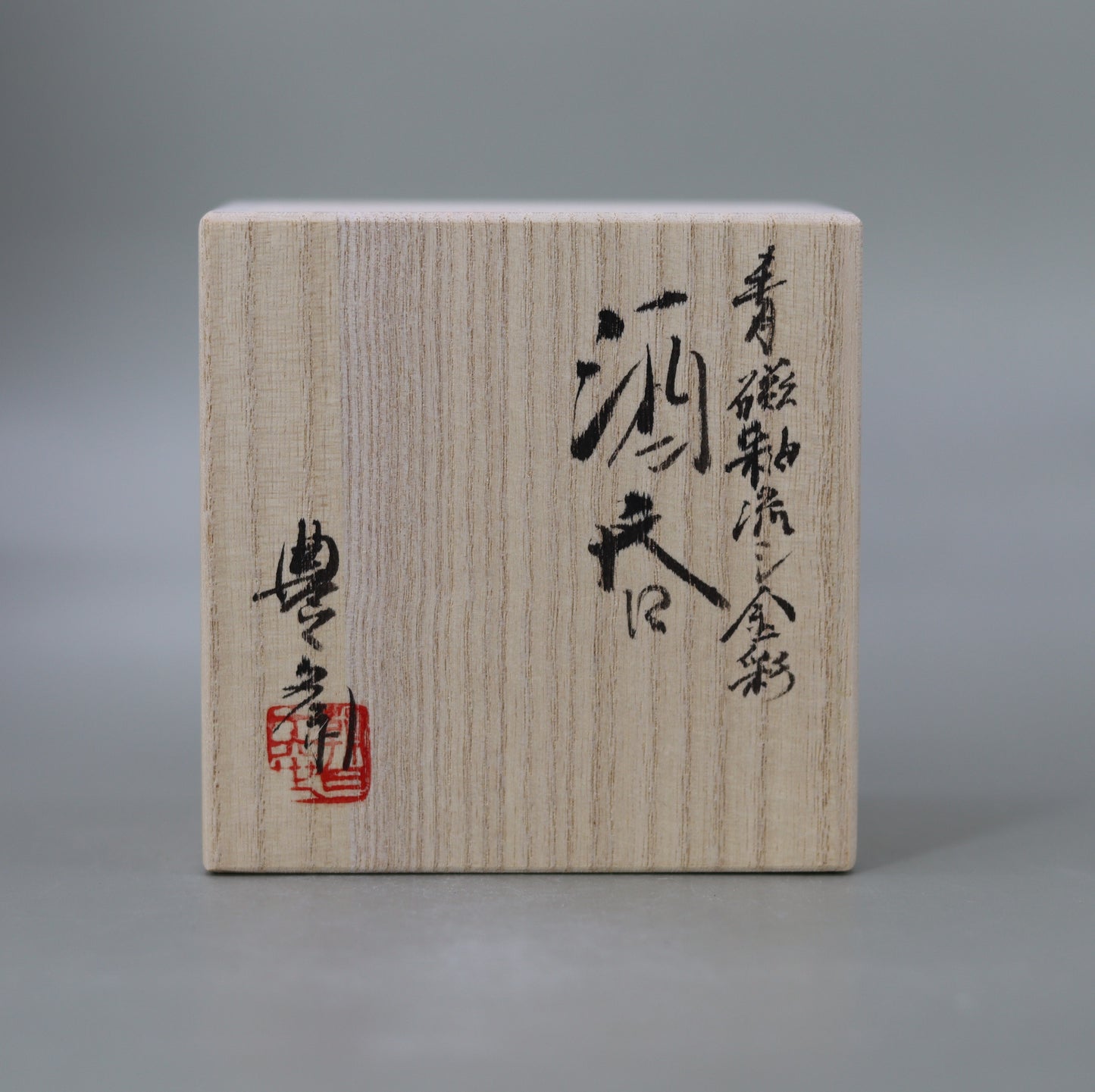
This is "Sake Cup: Celadon Glaze with Gold Embellishments" by Toyosai Matsubayashi XVI.
The pale, clear celadon glaze and boldly applied gold embellishments, combined with the expressions of white, grayish-blue, and reddish-brown clay and glaze, create an abstract painting-like scene within a single small vessel.
While Toyosai's "Gekkahaku (Moon White) Glaze Flow" exhibits a serene beauty, as if enveloped in a pale white, soft light, the celadon glaze used in this work possesses a more translucent, clear blue beauty. Even in Asahi-yaki, celadon is described as "a translucent pale blue," and its pristine color is a major charm of this sake cup.
A Clear, Water-like Scene Created by Celadon Glaze
Looking down into the cup, a pale celadon glaze spreads across the interior.
Unlike the soft, somewhat milky white-tinged blue of the Gekkahaku glaze, the celadon glaze has a transparency reminiscent of clear water. When it catches the light, it subtly changes its expression from pale blue to blue-green, creating a quiet, refreshing depth.
Especially when sake is poured, the color of the celadon glaze and the light of the liquid overlap, creating a different scene than when viewing an empty cup.
Asahi-yaki has continually researched how to beautifully develop glazes by utilizing the whiteness of the body, along with porcelain techniques. Celadon is one of the glazes that has been used throughout its history.
A Powerful Stroke of Gold Embellishment
What characterizes this sake cup is the bold gold embellishment applied across its body.
It is not a uniformly arranged decoration, but rather the movement of the brush, theかすれ (kasuri - blurred edges), and the varying shades of gold themselves are preserved as part of the scenery, making it interesting. The gold running through the subdued colors of pale celadon, white, gray, and reddish-brown instantly creates tension throughout the entire vessel.
Despite being a vibrant material, it is never excessive; instead, it enhances the quiet colors around it. This sense of applying decoration within negative space evokes a Japanese aesthetic, somewhat reminiscent of the Rinpa school.
Sculptural Form Carved Out
When viewed from the front, the cup has a soft outline, yet its surface features clear, angular lines from facet cutting.
As the vessel is turned, the orientation of the facets changes, revealing celadon glaze, white glaze, reddish-brown clay, and gold embellishments in succession. Therefore, the entire scope of the work cannot be grasped by viewing it from a single direction.
Particularly when viewed from the footring side, multiple facets converge around the footring, creating a sculptural quality reminiscent of a small雕刻 (sculpture).
On the other hand, a slight undulation remains at the mouthrim, preventing it from becoming overly geometric. The coexistence of neatness and traces of handwork also reveals Toyosai's unique contemporary sense of form.
Celadon and Gold That Change with Use
The quiet tones of the celadon glaze and the brilliance of the gold embellishments are attractive not only when appreciating the piece but also when sake is actually poured into it.
Because it is a small sake cup that fits in the palm of the hand, the way the gold embellishments shine changes with each lift, and the depth of the celadon glaze appears different.
The fun of this piece lies not just in viewing it head-on in a photograph, but in picking it up, turning it, pouring sake into it, and bringing it to your lips. The scenery within the cup will continuously transform throughout these actions.
Bringing Asahi-yaki's "Kirei-sabi" to the Present Day
Asahi-yaki is a kiln that has continued for over 400 years in Uji, inheriting the aesthetic of "Kirei-sabi" (elegant rusticity) from the tea master Kobori Enshu to this day.
Toyosai Matsubayashi XVI, while carrying on the traditional Kase and Benigase styles of Asahi-yaki, has also developed "Gekkahaku Glaze Flow," which was not seen in previous generations, as his unique style. Asahi-yaki's official website also introduces Gekkahaku Glaze Flow as a unique style of the 16th generation.
This "Sake Cup: Celadon Glaze with Gold Embellishments" also clearly reflects Toyosai's sensibility, venturing into contemporary forms through facet cutting, glaze flow, and gold embellishments, while building upon the refined foundation of traditional tea ceramics.
Pale, clear celadon, bold gold embellishments, and the color of the clay.
Different textures and colors clash on a single vessel, maintaining a mysterious balance.
This sake cup offers the opportunity to enjoy the unique clarity and dignified beauty of celadon, distinct from the soft, ethereal blue of the Gekkahaku glaze.
Toyosai Matsubayashi XVI
Born in Uji City, Kyoto Prefecture in 1980, as the eldest son of Toyosai Matsubayashi XV. He studied pottery wheel techniques at the Kyoto Prefectural Ceramic Art Advanced Technical School and apprenticed under his father. In 2015, he stayed and worked at the Leach Pottery in St Ives, England, and the following year, 2016, he succeeded as the 16th generation Toyosai of Asahi-yaki.
Based on Asahi-yaki, which has been passed down for over 400 years in Uji since the Keicho era, and the aesthetic of "Kirei-sabi" by the tea master Kobori Enshu, he creates tea ceramics such as tea bowls, tea caddies, water containers, and flower vases. While inheriting the traditional Kase and Benigase styles of Asahi-yaki, he has established "Gekkahaku (Moon White) Glaze Flow," a flowing pale bluish-white glaze, as his own unique style. Utilizing the expression of Uji clay and precise wheel throwing, he incorporates gold and silver embellishments and new forms, presenting works that harmonize tradition and modernity.
In addition to holding solo exhibitions throughout Japan, he has also presented his works overseas in London, Paris, New York, Taiwan, and Shanghai. His works are housed in the National Museum Wales. In 2020, he held a solo exhibition at the Nonaka-Hill Gallery in Los Angeles, and in 2023, he exhibited at "Leaping Creators" at the Kyoto City KYOCERA Museum of Art. In 2026, he will celebrate the tenth anniversary of his succession, and held commemorative tea ceramic exhibitions at Nihonbashi Mitsukoshi Main Store and Kyoto Takashimaya.
Share


-
[I will send it to you quickly and carefully]
We carefully package each product in a way that suits it best.
Also, delivery times vary depending on the piece (vessel, etc.).
Items that already come with a box will be shipped within 1-3 days of the order date.
For items that require a box to be made after your order, it will take approximately 30 days for production to be completed and then shipped.
In either case, once we have confirmed your order, we will contact you by email to inform you of the delivery date.
-
[Requests when purchasing pottery]
Even products that look the same may differ slightly in color, shape, size, etc.
The way the glaze is used, the power of the kiln, the firing method, the season, and the humidity also affect the appearance of the pottery.
Please understand the individuality of each piece of pottery and enjoy the unique warmth of handmade.