

Hotarude Sake Set "Yoimachi" by Chisato Taniguchi
Hotarude Sake Set "Yoimachi" by Chisato Taniguchi
Couldn't load pickup availability
Hotarude Sake Set "Yoimachi" by Chisato Taniguchi
Dimensions
Hotarude serving vessel: Diameter 23 × Height 8.1cm
Glass lid: Diameter 24 × Height 1.4cm
Hotarude sake server: 10.5 × 10 × Height 6cm
Hotarude sake cup: Diameter 5.4 × Height 5.2cm
――"In white porcelain vessels, the twilight glows like points of light. A sake set that elegantly enhances even the time spent waiting for sake."
Ⅰ First Impression of This Sake Set — "Within the Vessel, Another Night Resides"
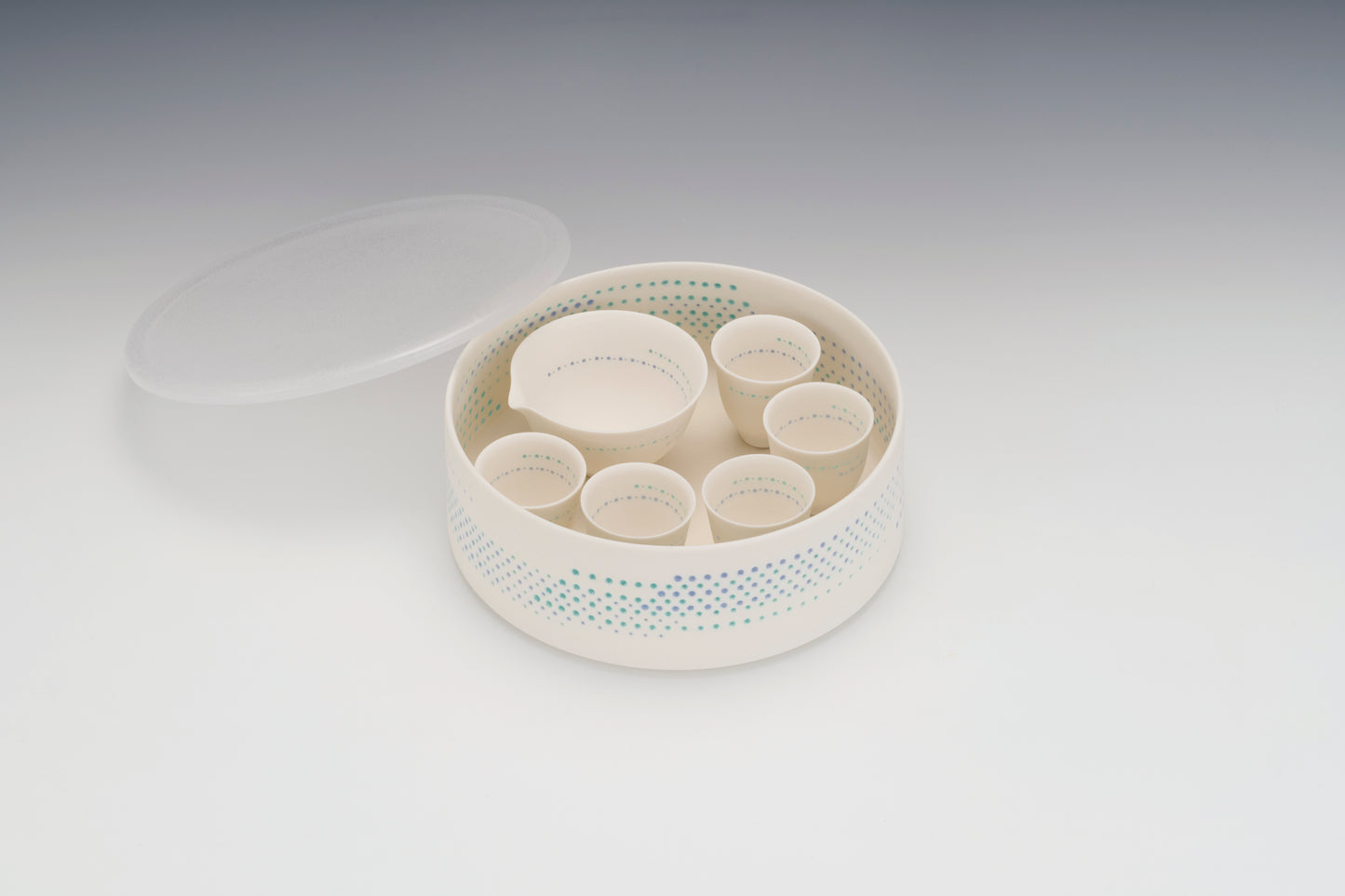
This work, "Hotarude Sake Set 'Yoimachi'," is a sake set featuring a sake server and sake cups housed within a white porcelain serving vessel, further adorned with a thin glass lid.
What is most striking is how the entire work resembles a miniature garden. The outer serving vessel is encircled by a band of blue-green dots, and inside, a similar continuous pattern of dots extends. Within this, the sake server and several sake cups are quietly nestled. Although a sake set, it is not merely a collection of tools. It is a small landscape, a piece that seems to encapsulate the atmosphere of a single night.
The title is "Yoimachi," meaning "waiting for twilight." It is the time just before night falls, after the sun has set. The light has not completely faded, yet the sharp edges of daytime are beginning to soften. This ambiguous and beautiful time is expressed through the soft white of the white porcelain and the continuous line of blue-green dots.
Within the vessel, there is a sake server for pouring sake, and sake cups to receive it. And encompassing them are the serving vessel and the translucent glass lid. The tranquility before use, the time spent waiting for sake, the gesture of opening the lid — all of these are part of this work's charm.
Ⅱ The Composition of the Serving Vessel — "A White Night Vessel" Enveloping the Sake Wares
The outer serving vessel measures 23 cm in diameter and 8.1 cm in height. It is a low, wide, cylindrical vessel.
This serving vessel is not merely a storage container. It is a stage that embraces the sake server and cups, setting the overall mood for the entire sake set. On the exterior, a large band of blue-green *hotarude* dots encircles it, creating a ripple-like movement on the white porcelain surface.
While the dots are arranged regularly, there are subtle variations in their density and shade. Areas where they cluster thickly, areas where they gently disperse, parts that appear as lines, and parts that spread as surfaces. This variation creates a quiet rhythm on the vessel's surface.
The dot pattern also extends to the interior, connecting the outside and inside. This is a major charm of this piece. It is not just a vessel with a pattern on the outside; even when you open the lid and peer inside, the blue-green dots meet your eye. In other words, the entire experience, from before use to the moment of opening and the act of taking out the pieces, has been meticulously designed.
It is a vessel that holds sake ware, and at the same time, a vessel that sets the atmosphere for a sake gathering. A serving vessel that embraces the twilight air within the stillness of white porcelain.
Ⅲ The Glass Lid — A Thin Veil, Casting the Haze of Twilight
This work is accompanied by a glass lid, 24 cm in diameter and 1.4 cm in height.
The presence of this glass lid makes the entire work profoundly poetic. It doesn't completely conceal the contents but covers them with a faint translucence. There is a sense of a thin haze, like the one that settles at the beginning of night. By covering the white porcelain sake wares with glass, the piece exists between "showing" and "hiding." The vessels inside are vaguely visible through the lid, creating anticipation even before it's opened. Though a sake set, there is a quiet tension, much like before opening a box of tea ceremony utensils.
The glass lid serves as a practical cover while also adding a layer of time to the entire work. Its presence means the sake wares are not yet in use, they are in a state of "waiting." This resonates precisely with the title "Yoimachi." The time before pouring sake. The time before welcoming guests. The time just before opening the lid. This anticipation of waiting is beautifully preserved by the thin film of glass.
Ⅳ The Sake Server — A Soft Core Residing in a Vessel for Pouring
The sake server placed in the center, though small, is the focal point of the sake set.
A *katakuchi* (sake server) is a vessel for holding sake and pouring it into cups. As such, it is arguably the most dynamic tool in a sake set. The *katakuchi* in this work has the soft roundness of white porcelain, with a part of its spout gently flaring outwards. This small pouring spout imparts natural movement to its otherwise tranquil form.
Inside, blue-green dots arc gracefully, creating a beautiful effect when sake is poured and the water's surface overlaps with the pattern. When filled with sake, the string of dots sinks below the surface or faintly floats near the rim. The small blue-green lines drawn on the inner surface of the vessel resonate with the transparency of the sake.
Ⅴ The Sake Cup — A Ring of Dots Floating Within a Small Vessel
The sake cup is 5.4cm in diameter and 5.2cm in height. It is small enough to fit comfortably in the palm of one's hand.
This sake cup also features blue-green dots arranged in a circular pattern on the inside. Being a small vessel, the dot pattern does not spread as widely as on the outer serving vessel. Instead, it creates a quiet focal point within the cup. When sake is poured, the continuous line of dots will sink below the liquid surface and subtly waver due to light refraction. Lifting the cup and bringing it to one's lips, in that brief action, the blue-green dots might appear like bubbles in water or tiny stars scattered across the night sky.
The charm of the sake cup is its understated nature. It is refined as a small white porcelain vessel, with just a hint of blue-green presence. It doesn't interfere with the color or aroma of the sake, yet it leaves a definite impression on the person holding it.
The presence of multiple sake cups creates a subtle continuity at the sake gathering. Each cup, while sharing the same ambiance, will have slight differences in how the dots appear and are arranged. This is where the beauty of handmade craftsmanship lies.
Ⅵ The Expression of Hotarude — Holes, Light, and Dots Creating "Particles of Twilight"
In Chisato Taniguchi's work, the *hotarude* dots are not mere decoration.
By piercing tiny holes in the white porcelain body and imbuing them with blue-green light, a sense of transparency and depth is created on the vessel's surface. In this work, these dots repeatedly appear on the serving vessel, sake server, and sake cups. They are on the outside, and on the inside, on both large and small vessels. The repetition of dots creates a unified atmosphere throughout the entire sake set.
These dots also resemble lights at night. Not yet full night, but the time when lights gradually increase in the twilight sky. This atmosphere appears as blue-green grains on the white porcelain surface. Furthermore, the dot pattern evokes an impression of water: sake, water surface, bubbles, ripples. The use as sake ware and the expression of the *hotarude* dots are naturally intertwined. Sake fills the cup, is poured from the sake server, and the vessels are arranged inside the serving vessel. In all these scenes, the blue-green dots function as an indication of water and light.
Ⅶ Its Appearance at the Sake Table — Opening the Lid, Taking Out the Vessels, Pouring Sake
The charm of this work doesn't end with simply admiring it. Rather, its expression deepens through the act of using it. First, remove the glass lid. The white porcelain sake wares, previously subtly concealed, are revealed. Inside the serving vessel, the sake server and cups are quietly nestled. At that moment, a sense of ritual is born at the sake table.
Next, take out the sake server and pour the sake. The sake enters the white porcelain, and the blue-green dots merge with the liquid surface. As it's poured into the cup, the dots then shimmer within the small vessel. Even before drinking the sake, one's gaze and hand movements are already being refined. This sake set is not for vigorous drinking. It is for quietly and slowly savoring a small amount of sake. Chilled sake, a clear, delicate sake, or perhaps one with a subtle aroma would be well-suited. The transparency of the sake, the cleanliness of the white porcelain, and the refreshing feel of the blue-green dots combine beautifully.
This sake set is designed to make the time spent waiting for, pouring, and drinking sake beautiful.
Ⅷ The Title "Yoimachi" — Making Even the Time Before Use Part of the Work
The title "Yoimachi" (Waiting for Twilight) is perfectly suited to this work.
"Waiting for twilight" is not about night itself, but about awaiting the atmosphere just before night. The light gradually fades, the air softens, and each light begins to hold meaning. This time holds not extravagance, but expectation and tranquility. The same is true for this work. While covered by the glass lid, the sake wares are not yet in use. The sake server and cups quietly await within the serving vessel. Blue-green dots glow there. It is truly a vessel waiting for the beginning of a sake gathering.
By opening the lid, twilight begins. By picking up the sake server, time starts to move. By pouring sake into the cups, a small night fills the white porcelain. This piece is not only a vessel for drinking sake but also a work that embodies the beautiful silence before drinking sake.
Ⅸ Conclusion — A Set That Encapsulates the Serenity of a Sake Gathering in White Porcelain
The "Hotarude Sake Set 'Yoimachi'" is a sake set where white porcelain, *hotarude*, glass, a sake server, and sake cups are composed into a single world.
The serving vessel becomes a white stage encompassing the sake wares, and the glass lid covers the vessels like the haze of twilight. The sake server becomes the center for pouring sake, and the cups become small vessels of night receiving that sake. And throughout all of them, blue-green dots subtly circulate.
Chisato Taniguchi's *hotarude* expression is here very naturally linked to its use as sake ware. The dots are bubbles, ripples, lights, and stars. When sake is poured, these dots further shimmer, and the vessel is completed in the hands of the user.
This is not a sake set that relies on strong colors or flamboyant designs. Rather, it is a piece where blue-green grains subtly breathe within the tranquility of white porcelain. It creates a refreshing space at the sake table and quietly enhances the time spent with guests.
Waiting for twilight, opening the lid, pouring sake, sharing cups.
It is a clear and poetic sake set that makes this entire sequence of time beautiful.
Biography
1976 Born in Higashiyama, Kyoto
1999 Graduated from Doshisha University, Faculty of Law
2000 Completed Kyoto Prefectural Technical School for Ceramic Arts
2001 Completed Kyoto Municipal Industrial Research Institute
2002 Apprenticed under Yasutaka Shimizu
2010 Assisted with glass production
2019 Resumed ceramic work
2024 Kyoto Mayor's Award at the Kyo-yaki / Kiyomizu-yaki Exhibition
2025 Special Award (Gallery Yamasakiki Award) at the 12th Tobi Exhibition
2025 TOKI Oribe Grand Prize at the 17th Contemporary Tea Pottery Exhibition
Present Full member of the Japan Crafts Council
Share
-
[I will send it to you quickly and carefully]
We carefully package each product in a way that suits it best.
Also, delivery times vary depending on the piece (vessel, etc.).
Items that already come with a box will be shipped within 1-3 days of the order date.
For items that require a box to be made after your order, it will take approximately 30 days for production to be completed and then shipped.
In either case, once we have confirmed your order, we will contact you by email to inform you of the delivery date.
-
[Requests when purchasing pottery]
Even products that look the same may differ slightly in color, shape, size, etc.
The way the glaze is used, the power of the kiln, the firing method, the season, and the humidity also affect the appearance of the pottery.
Please understand the individuality of each piece of pottery and enjoy the unique warmth of handmade.