


Blue and white porcelain incense ware Kazuhiro Matsukawa
Blue and white porcelain incense ware Kazuhiro Matsukawa
Couldn't load pickup availability
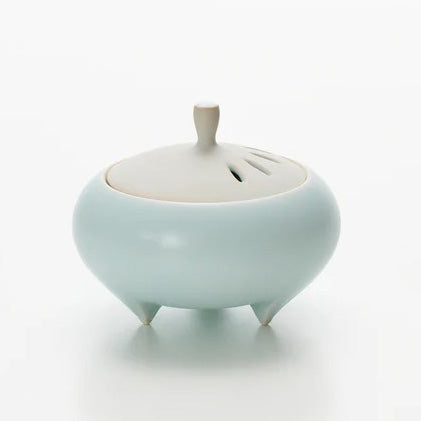
Blue and white porcelain incense burner by Kazuhiro Matsukawa (Φ: 8.2cm H: 7.0cm)
-- "The tranquility of the color of water. The fragrance rising from the watermark is as soft as morning mist."
Ⅰ The incense vessel as the "starting point of tranquility"
An incense burner is not only a tool for burning incense, but also the starting point for adjusting the atmosphere during a tea ceremony. Although the incense is invisible, as it rises, it clarifies the contours of the space and quietly harmonizes the breathing of the guests.
This "Blue and White Porcelain Incense Burner" embodies in its easy-to-handle dimensions of Φ8.2 x H7.0 the ideal requirements of an incense burner - that the incense should gently release, not disturb the space, yet leave a lasting impression - in a neat and tidy form. Though it is small, it brings a space to a tranquil state the moment it is placed in the room. This incense burner begins the "preparation for tranquility" even before the incense is burned.
II. The appeal of pale blue porcelain: "Clearer than white, softer than blue"
2-1 Pale blue porcelain surface: Still water containing light
Blue-and-white porcelain is a world based on the purity of white porcelain, with hints of very pale blue. The pale blue in this piece does not assert itself as a color, but rather softly captures light, and the smooth transition of shadows along the gradient of the surface creates a tranquility like the surface of water .
A clear temperature somewhere between the tension of white and the coolness of blue. Its exquisite thinness creates a space that is appropriate for a tool such as an incense vessel.
2-2 Contrast with the White Fire House: Purity becomes two-tiered
The body of the incense vessel is pale blue, while the fire lid (the white lid on top) is white. The intersection of these two whites prevents the vessel from being monotonous, and deepens its purity in two layers. Pale blue represents air, and white represents light. The contrast between the two echoes the incense's invisible nature, elevating its status as a vessel for receiving something invisible.
III. Shape and Design: Giving shape to the incense path
3-1 The floating feeling of a tripod: the purity that comes from being away from the floor
The greatest appeal of this piece is the way the vessel is slightly elevated by the tripod. While an incense vessel is a tool that uses fire, it also symbolizes "purity" in the tea ceremony. As the vessel floats above the floor and a shadow is cast beneath it, the vessel acquires a layer of visual purity .
Furthermore, the more the scent rises quietly from a low position, the more beautiful it is. The tripod is not just a design element; it also prepares the vessel for a story of the scent rising up.
3-2 Openwork design: To ensure the fragrance stands out in a balanced way
The openworks on the fire shed are arranged in a rhythmic radial pattern, and serve to regulate the flow of incense. It is not enough for the incense to spray out strongly; it is important that it rises quietly, evenly, yet surely.
The rhythm of the openwork gently regulates the speed and intensity of the fragrance, adjusting the "quality" of the fragrance as it spreads through the space.It can be said that this composition presents the invisible path of the fragrance as a visible design.
3-3 Picking point: Upward will tightens the whole
The knob in the center stands out as a small protrusion reminiscent of a bud or drop, providing a point of tension in the white world. This point connects the horizontality (stability) of the vessel and the verticality (ascent) of the incense, visualizing its meaning as an incense vessel. Though small in size, it is the key element that determines the overall posture.
IV. Resonance with History: Incense and the Spirituality of White Porcelain and Blue-and-White Porcelain
Since ancient times, incense has been used to purify a space, calm the mind, and change the flow of time. The culture of incense respects the invisible, avoids excessive decoration, and seeks precision in its presence.
The pale blue porcelain material is not flashy, but rather contributes to the clarity of the space. The black creates tension, the white allows breath, and the pale blue creates the depth of still water. This piece captures the invisible world of incense with the power of the pale blue. The space becomes clear even before the incense is released. This clarity is the aesthetic of pale blue porcelain and the essence of an incense vessel.
summary
This pale blue porcelain incense burner by Kazuhiro Matsukawa is a masterpiece that combines the functional beauty of an incense burner with the clear serenity of pale blue porcelain, all in its small dimensions of Φ8.2 x H7.0. The tripod creates a floating feeling, the openwork harmonizes the fragrance, and the two layers of purity created by the white husk and the pale blue body.
Simply placing it in a tea ceremony setting quietly brings the space into order, and the moment the incense rises, the contours of the space become even clearer. This incense burner is a refined embodiment of the "precise presence" sought by incense culture.
Biography
1977 Born in Kawachinagano, Osaka Prefecture
1998 Graduated from Nara College of Arts, Ceramic Art Course
2000 Graduated from Nara College of Arts
2001 Graduated from Kyoto Prefectural Pottery Technical College and studied under Takahiro Kondo
2006 Independent and opened a kiln in Kawachinagano City
Major solo exhibitions and exhibitions
2007 Kyoto Prefecture Fine Arts and Crafts New Artists Selection Exhibition (Kyoto Museum)
Two-person exhibition (Matsuzakaya Nagoya Art Gallery/Nagoya)
Solo exhibition (Kyoto Takashimaya Art and Craft Salon/Kyoto)
2008 Solo Exhibition (Campanule/Chiba)
Solo exhibition (Paramita Museum Small Gallery/Mie)
2009 Solo Exhibition (Gallery Espace/Nagoya)
2010 Solo Exhibition (Sapporo Mitsukoshi Art Gallery/Hokkaido)
Solo exhibition (Matsuzakaya Nagoya Art Gallery/Nagoya)
Solo exhibition (Alpark Tenmaya Art Gallery/Hiroshima)
2011 Solo Exhibition (Ceramics Gallery Furyo/Osaka) ('07)
2012 Solo Exhibition (Gallery Okumura/Tokyo) ('07 '09)
2013 Solo Exhibition (Lovely Hall 20th Anniversary Event/Osaka)
2014 Solo Exhibition (Tenmaya Hiroshima Hatchobori Art Gallery/Hiroshima) ('11)
2016 Solo Exhibition (Tenmaya Fukuyama Art Gallery/Hiroshima) ('08 '12)
Three-person exhibition (Hakata Hankyu Muse/Fukuoka)
2017 Solo Exhibition (Pinacotheca / Tokyo) ('14 '15)
Solo exhibition (Tenmaya Okayama Art Gallery/Okayama) ('08)
Solo exhibition (Atelier Hiro/Osaka)
2018 Solo Exhibition (Nihonbashi Mitsukoshi Main Store Art Gallery/Tokyo)
Solo exhibition (Takashimaya Osaka Gallery NEXT/Osaka) ('08 '11 '15)
2020 Solo Exhibition (Hana Asagi/Tokyo)
2021 Solo Exhibition (Gallery Tachibana/Nara) ('15 '17 '19)
2022 Two-person exhibition (Hana Asagi/Tokyo)
2023 Two-person exhibition (Atelier Hiro/Osaka)
2025 Two-person exhibition (Hana Asagi/Tokyo)
Solo exhibition (Midorigaoka Museum of Art/Nara)
Awards
36th Japan Traditional Crafts Kinki Exhibition (Osaka Prefecture Board of Education Award)
55th Japan Traditional Crafts Exhibition (Japan Crafts Association President's Award)
Public Collection
Midorigaoka Museum of Art
Share

-
[I will send it to you quickly and carefully]
We carefully package each product in a way that suits it best.
Also, delivery times vary depending on the piece (vessel, etc.).
Items that already come with a box will be shipped within 1-3 days of the order date.
For items that require a box to be made after your order, it will take approximately 30 days for production to be completed and then shipped.
In either case, once we have confirmed your order, we will contact you by email to inform you of the delivery date.
-
[Requests when purchasing pottery]
Even products that look the same may differ slightly in color, shape, size, etc.
The way the glaze is used, the power of the kiln, the firing method, the season, and the humidity also affect the appearance of the pottery.
Please understand the individuality of each piece of pottery and enjoy the unique warmth of handmade.