


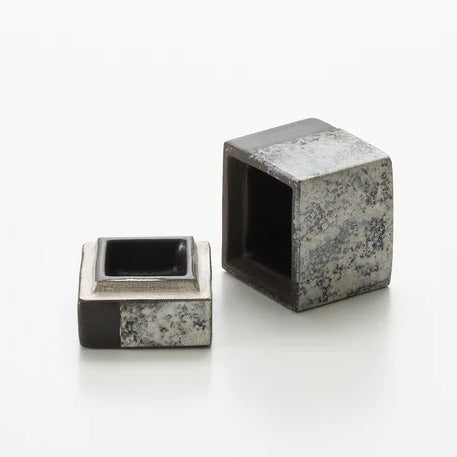
Black and white ceramic box by Kazuhiro Matsukawa
Black and white ceramic box by Kazuhiro Matsukawa
Couldn't load pickup availability
Black and white ceramic box by Kazuhiro Matsukawa (W4.9 x D4.6 x H6.2cm)
-- "White is 'white space', black is 'silence'. A landscape resides in this small cube."
I. The ceramic box as a vessel: By "putting it away," a presence emerges
A ceramic box is not just a box for storing things. It is a tool that elevates the very act of storing, protecting, and arranging things into a beautiful form. The series of quiet movements of fitting the lid, checking the corners with your fingertips, lifting it up and putting it back down creates the "ma" (space) that is so important in the tea ceremony.
This piece measures W4.9 x D4.6 x H6.2cm , small enough to fit in the palm of your hand, yet has a solid cubic volume that establishes the center of gravity in the space the moment you place it down. It's small, yet not "weak." This is the strength of Kazuhiro Matsukawa's design.
II. Dialogue between Black and White: Two Colors as "Scenery"
The greatest appeal of this work is that black and white are not simply a color scheme, but resonate with each other as a difference in texture and time . The black creates a calming surface that absorbs light, strengthening the contours. The white contains stone-like spots and is covered in subtle shadows, deepening the "white space."
The white is not purely bright, but has a rough, granular texture that gives it a sense of presence rather than coldness. The black is not simply heavy, but rather acts as a sense of firmness as the surfaces are refined. As a result, the two colors complement each other, with white representing breath and black representing silence , creating a sense of tension every time you look at it.
III. Cube design: dignity created by straight lines
A cube is the simplest and therefore most indistinguishable shape. If the corners are rough, it looks childish, and if the faces are wavy, it looks unsettling.
This piece has beautifully defined corners and a firm surface, without being too cold or hard. This is because the final shape was achieved by carefully reading the firing and the settling of the glaze.
Furthermore, the boundary between the lid and the body is not simply a seam, but acts as a horizontal line that calms the vessel . The eye stops there for a moment, then slides across the black and white surfaces. Although this is a small piece, the way it is designed to guide the viewer is extremely appealing.
IV. Suggested uses: for incense, sweets, and small treasures
What's great about this ceramic box is that it can be used for more than one purpose. In the context of the tea ceremony, it can be used in a wide variety of ways, including:
As an incense holder : A container for storing incense paste or pieces of fragrant wood, along with their aroma.
For small sweets such as dried sweets, sugar candy, and amber sugar : the black brings out the sweetness, while the white adds a clean feeling.
For storing small props at tea ceremonies : A box for organizing small tools such as small nails, incense chopsticks, and fasteners.
In modern life : A place to store small, important everyday items such as rings, earrings, seals, medicine, and USBs.
The black and white duality of this piece blends seamlessly into not only traditional Japanese interiors, but also modern decor. Simply placing it in a corner of a shelf will tighten up the space.
V. Black and White Aesthetics: The Intersection of "Wabi-Sabi" and "Modernity"
What the tea ceremony has always valued is not flashy decoration, but the power that resides in the blank spaces. This piece truly brings to the forefront the beauty of form, surface, and quality that remains after the decoration has been stripped away.
However, this is not a nostalgia for the classics. The black and white contrast, the abstractness of the cube, and the strong texture of the material all directly link to modern aesthetics - minimalism, architecture, and sculpture.
In other words, this ceramic box is a small sculpture that maintains the tranquility of the tea ceremony while possessing the strength to withstand a modern space .
Ⅵ Handling (Notes for works that are not Ginsai)
The black and white texture of this piece is its charm, so daily care is simple and sufficient. After use, wipe gently with a soft cloth, rinse with water if necessary, and dry thoroughly. Please refrain from using abrasive sponges as they may damage the appearance. Since the piece has a lid, it is best to let it air out occasionally when storing it to prevent moisture from building up inside.
summary
The black and white ceramic box is a work of art that condenses the tension between black and white, the dignity of the surface and corners, and the beauty of the act of putting away, into a piece that fits in the palm of your hand.
The moment you close the lid, the space quietly becomes tidy - this is a product that you can enjoy the experience of in your hands.
Biography
1977 Born in Kawachinagano, Osaka Prefecture
1998 Graduated from Nara College of Arts, Ceramic Art Course
2000 Graduated from Nara College of Arts
2001 Graduated from Kyoto Prefectural Pottery Technical College and studied under Takahiro Kondo
2006 Independent and opened a kiln in Kawachinagano City
Major solo exhibitions and exhibitions
2007 Kyoto Prefecture Fine Arts and Crafts New Artists Selection Exhibition (Kyoto Museum)
Two-person exhibition (Matsuzakaya Nagoya Art Gallery/Nagoya)
Solo exhibition (Kyoto Takashimaya Art and Craft Salon/Kyoto)
2008 Solo Exhibition (Campanule/Chiba)
Solo exhibition (Paramita Museum Small Gallery/Mie)
2009 Solo Exhibition (Gallery Espace/Nagoya)
2010 Solo Exhibition (Sapporo Mitsukoshi Art Gallery/Hokkaido)
Solo exhibition (Matsuzakaya Nagoya Art Gallery/Nagoya)
Solo exhibition (Alpark Tenmaya Art Gallery/Hiroshima)
2011 Solo Exhibition (Ceramics Gallery Furyo/Osaka) ('07)
2012 Solo Exhibition (Gallery Okumura/Tokyo) ('07 '09)
2013 Solo Exhibition (Lovely Hall 20th Anniversary Event/Osaka)
2014 Solo Exhibition (Tenmaya Hiroshima Hatchobori Art Gallery/Hiroshima) ('11)
2016 Solo Exhibition (Tenmaya Fukuyama Art Gallery/Hiroshima) ('08 '12)
Three-person exhibition (Hakata Hankyu Muse/Fukuoka)
2017 Solo Exhibition (Pinacotheca / Tokyo) ('14 '15)
Solo exhibition (Tenmaya Okayama Art Gallery/Okayama) ('08)
Solo exhibition (Atelier Hiro/Osaka)
2018 Solo Exhibition (Nihonbashi Mitsukoshi Main Store Art Gallery/Tokyo)
Solo exhibition (Takashimaya Osaka Gallery NEXT/Osaka) ('08 '11 '15)
2020 Solo Exhibition (Hana Asagi/Tokyo)
2021 Solo Exhibition (Gallery Tachibana/Nara) ('15 '17 '19)
2022 Two-person exhibition (Hana Asagi/Tokyo)
2023 Two-person exhibition (Atelier Hiro/Osaka)
2025 Two-person exhibition (Hana Asagi/Tokyo)
Solo exhibition (Midorigaoka Museum of Art/Nara)
Awards
36th Japan Traditional Crafts Kinki Exhibition (Osaka Prefecture Board of Education Award)
55th Japan Traditional Crafts Exhibition (Japan Crafts Association President's Award)
Public Collection
Midorigaoka Museum of Art
Share


-
[I will send it to you quickly and carefully]
We carefully package each product in a way that suits it best.
Also, delivery times vary depending on the piece (vessel, etc.).
Items that already come with a box will be shipped within 1-3 days of the order date.
For items that require a box to be made after your order, it will take approximately 30 days for production to be completed and then shipped.
In either case, once we have confirmed your order, we will contact you by email to inform you of the delivery date.
-
[Requests when purchasing pottery]
Even products that look the same may differ slightly in color, shape, size, etc.
The way the glaze is used, the power of the kiln, the firing method, the season, and the humidity also affect the appearance of the pottery.
Please understand the individuality of each piece of pottery and enjoy the unique warmth of handmade.