

Blue and white porcelain Hiryu Maruko Kazuhiro Matsukawa
Blue and white porcelain Hiryu Maruko Kazuhiro Matsukawa
Couldn't load pickup availability
Blue and white porcelain Hiryu round goiko (Φ7.8×h7.0)
-- "A flash of scarlet in the stillness of pale blue. A vessel that seals a 'scenery' within a sphere."
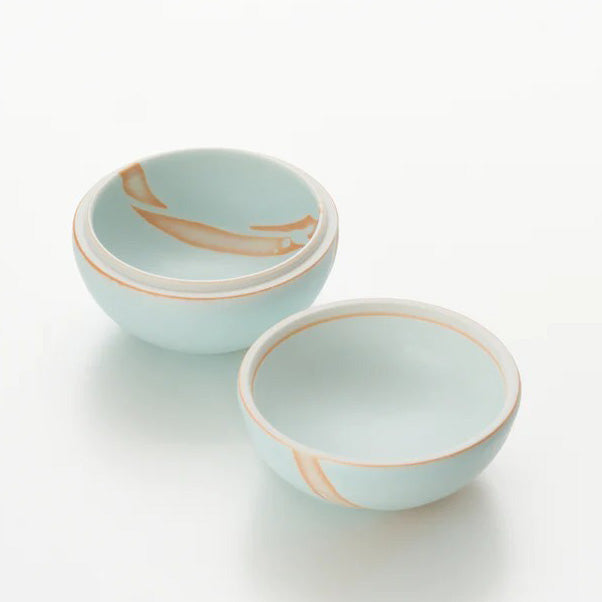
This work, "Blue and White Porcelain Scarlet Round Bowl," is based on the purest form of a sphere, combining the clear glaze of blue and white porcelain with the warm traces of red flowing water, creating a bowl that embodies "stillness and movement" unique to Matsukawa Kazuhiro. With a diameter of 7.8 cm and a height of 7.0 cm, it fits in the palm of your hand, making it both easy to use as a tool and dense enough for appreciation. While bowls can also be used to "protect" incense, small sweets, or precious items by "covering" them, this work has a deeper meaning, as if it were sealing in a landscape itself, quietly revealing it only when necessary.
I. The form of the "Maru-goko" - the silent perfection brought about by the sphere
The sphere is flawless from any angle, and the surface that catches the eye always gently curves around, giving it a sculptural presence despite being a vessel. Moreover, as a goso, the boundary between the body and the lid appears as a continuous line. This "boundary" is not just a seam, but also appears to be a "barrier" that separates two worlds: outside and inside, the visible and the invisible, before and after the fragrance is released. The smooth surface of the sphere reflects the light, casting soft shadows and exuding a quiet volume reminiscent of the surface of the moon. Matsukawa Kazuhiro's firm sense of form can be felt in the way that the form itself emerges as a form of beauty, rather than as an overly assertive decoration.
II. Glaze Tones of Blue-and-White Porcelain: A Color Range “Clearer than White, Softer than Blue”
While pale blue porcelain appears to lie somewhere between the cleanliness of white porcelain and the depth of celadon, it is actually a color that belongs to another dimension. Not appearing as hard as white, nor as densely settled as blue, its light, pale blue color creates a sense of space on the vessel's surface, as if it were breathing. From the photograph, we can see that not only is the surface smooth and evenly formed, but also that extremely fine shadows are accumulated, with the color fluctuating between light and dark within the curves. This expression can only be achieved when the thickness of the glaze, the firing temperature range, and the density of the body are all in harmony, demonstrating that the appeal of pale blue porcelain emerges not as a "color" but as a "state of light."
III. The Meaning of Hinagashi: Traces of the Book of Fire, Not a Coincidence
The greatest highlight of this work is the flow of scarlet across the stillness of the pale blue porcelain. The scarlet flow is a trace of reddish-orange that appears on the glaze (or at the edge of the glaze), a "brushstroke of fire" created by the reaction of the heat of firing and the ingredients. What is important here is that the scarlet is not simply placed as a striking accent, but rather the flow "runs," "breaks," and "overlaps" as it follows the curved surface of the sphere. It is as if the line, drawn in a single stroke, breathes, changes speed along the way, and then suddenly disappears at the end -- a sense of movement remains.
While pale blue porcelain evokes cold, clear elements such as "water," "air," and "morning mist," Hiryu brings with it warm elements such as "fire," "sunset glow," and "iron in the earth." In other words, by engraving a single, yet decisive, memory of flame on the extremely pure material of porcelain, this piece expands the expression of the vessel into a realm that is "more than just infinitely quiet."
IV. Use as a container: a small universe in the palm of your hand, containing incense, sweets, and small items
A goko is a versatile vessel for both tea ceremonies and everyday use. For example, it can be used similarly to an incense container, and by storing pieces of fragrant wood, small incense pieces from Kosaido, or kneaded incense, a "place of fragrance" will emerge the moment you open the lid. It can also be used as a small container to hold a small amount of dried sweets at a thin tea ceremony, where the pale blue of the blue-and-white porcelain brings out the color of the sweets and the scarlet adds a touch of elegance. It can also be used to store small personal items such as small stones, konpeito sugar, rings, or seals that you have acquired during your travels.
The spherical container has a softer interior space than a square one, and the act of opening the lid feels somewhat ritualistic. The appeal of this piece lies in the fact that the very actions of putting away, protecting, and opening the container are part of the aesthetic sense.
V. Porcelain with a "scenery" - A glimpse of the seasons in tranquility
Matsukawa Kazuhiro's blue-and-white porcelain is not simply elegant and beautiful, but also has the power to evoke the "signs of the seasons" in the viewer. The addition of the scarlet flow makes the seasonal feeling even more concrete. For example, the pale blue surface evokes the chill of a winter morning or the haze of early spring, while the scarlet resembles a sunset, the vestiges of autumn leaves, or the glow of a brazier. The sphere is reminiscent of a celestial body, and the scarlet flow can be read as an orbit around it.
In other words, this box creates a small universe in the palm of your hand, and the scarlet "trace of time" runs over the "quality of tranquility" of pale blue porcelain. When you close the lid, silence returns, and when you open it, the blue inside suddenly appears -- this repetition slowly regulates the owner's time.
Ⅵ Handling Techniques - Making the most of the delicateness of the scarlet, which is not a silver color
Because the expression of the Hiryu style on this piece is delicate, there is no need to force a shine by rubbing or polishing it hard. The basic method is to wipe it dry with a soft cloth, and if it gets dirty, wash it gently with diluted neutral detergent and dry it thoroughly. The fit between the lid and the body of the container is directly related to the beauty of the piece, so when opening and closing it, do not twist it forcefully with one hand, but handle it with both hands to keep it "level," and it will remain beautiful as a tool and can be used for a long time.
The blue-and-white porcelain red round bowl is not an eye-catching piece with an ornate design, but rather a piece that awakens the viewer's senses from deep within by instilling a ray of warmth within its stillness. The moment the memory of fire comes into contact with the transparent presence of Matsukawa Kazuhiro's blue-and-white porcelain - this bowl allows you to experience that "slight drama" over and over again in the palm of your hand.
Biography
1977 Born in Kawachinagano, Osaka Prefecture
1998 Graduated from Nara College of Arts, Ceramic Art Course
2000 Graduated from Nara College of Arts
2001 Graduated from Kyoto Prefectural Pottery Technical College and studied under Takahiro Kondo
2006 Independent and opened a kiln in Kawachinagano City
Major solo exhibitions and exhibitions
2007 Kyoto Prefecture Fine Arts and Crafts New Artists Selection Exhibition (Kyoto Museum)
Two-person exhibition (Matsuzakaya Nagoya Art Gallery/Nagoya)
Solo exhibition (Kyoto Takashimaya Art and Craft Salon/Kyoto)
2008 Solo Exhibition (Campanule/Chiba)
Solo exhibition (Paramita Museum Small Gallery/Mie)
2009 Solo Exhibition (Gallery Espace/Nagoya)
2010 Solo Exhibition (Sapporo Mitsukoshi Art Gallery/Hokkaido)
Solo exhibition (Matsuzakaya Nagoya Art Gallery/Nagoya)
Solo exhibition (Alpark Tenmaya Art Gallery/Hiroshima)
2011 Solo Exhibition (Ceramics Gallery Furyo/Osaka) ('07)
2012 Solo Exhibition (Gallery Okumura/Tokyo) ('07 '09)
2013 Solo Exhibition (Lovely Hall 20th Anniversary Event/Osaka)
2014 Solo Exhibition (Tenmaya Hiroshima Hatchobori Art Gallery/Hiroshima) ('11)
2016 Solo Exhibition (Tenmaya Fukuyama Art Gallery/Hiroshima) ('08 '12)
Three-person exhibition (Hakata Hankyu Muse/Fukuoka)
2017 Solo Exhibition (Pinacotheca / Tokyo) ('14 '15)
Solo exhibition (Tenmaya Okayama Art Gallery/Okayama) ('08)
Solo exhibition (Atelier Hiro/Osaka)
2018 Solo Exhibition (Nihonbashi Mitsukoshi Main Store Art Gallery/Tokyo)
Solo exhibition (Takashimaya Osaka Gallery NEXT/Osaka) ('08 '11 '15)
2020 Solo Exhibition (Hana Asagi/Tokyo)
2021 Solo Exhibition (Gallery Tachibana/Nara) ('15 '17 '19)
2022 Two-person exhibition (Hana Asagi/Tokyo)
2023 Two-person exhibition (Atelier Hiro/Osaka)
2025 Two-person exhibition (Hana Asagi/Tokyo)
Solo exhibition (Midorigaoka Museum of Art/Nara)
Awards
36th Japan Traditional Crafts Kinki Exhibition (Osaka Prefecture Board of Education Award)
55th Japan Traditional Crafts Exhibition (Japan Crafts Association President's Award)
Public Collection
Midorigaoka Museum of Art
Share


-
[I will send it to you quickly and carefully]
We carefully package each product in a way that suits it best.
Also, delivery times vary depending on the piece (vessel, etc.).
Items that already come with a box will be shipped within 1-3 days of the order date.
For items that require a box to be made after your order, it will take approximately 30 days for production to be completed and then shipped.
In either case, once we have confirmed your order, we will contact you by email to inform you of the delivery date.
-
[Requests when purchasing pottery]
Even products that look the same may differ slightly in color, shape, size, etc.
The way the glaze is used, the power of the kiln, the firing method, the season, and the humidity also affect the appearance of the pottery.
Please understand the individuality of each piece of pottery and enjoy the unique warmth of handmade.