

Blue and white porcelain box "Scarlet" by Kazuhiro Matsukawa
Blue and white porcelain box "Scarlet" by Kazuhiro Matsukawa
Couldn't load pickup availability
Blue and white porcelain box "Scarlet" by Kazuhiro Matsukawa
W8.2 × D8.5 × H8.0 cm
-- "A ray of presence runs through the quiet blue. The vessel that holds it harbors the scenery."
Ⅰ Ceramic boxes as a form of storage
In the tea ceremony, a ceramic box is a container for storing incense, sweets, or small utensils, but it is also a container that transforms the way it is stored into a form of beauty. When the lid is closed, it becomes a sculpture, and when opened, another landscape appears inside, and it even regulates the flow of time when you hold it in your hands.
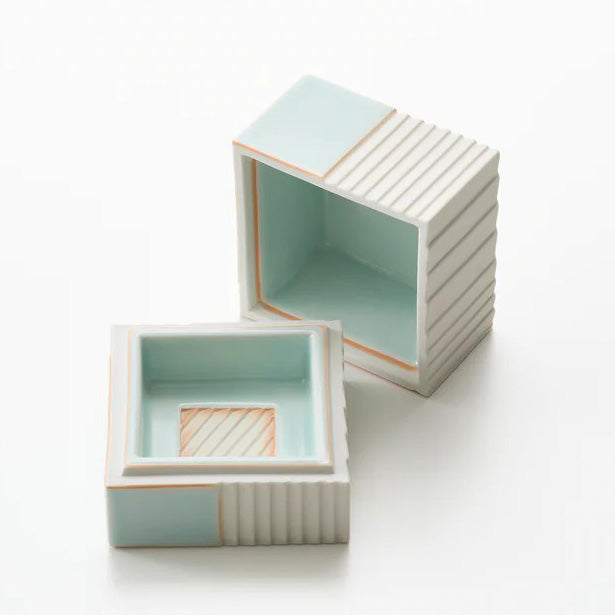
This piece creates a sense of tension in both the eye and the touch with its neat, nearly cubic mass and the repeated ridges (carved stripes) running along one side . The primary appeal of this piece is that, while it is a vessel for storing things, the vessel itself stands out like "architecture that designs the atmosphere of the space."
II. The clarity of pale blue porcelain: "tranquility" rather than "coldness"
Unlike the hardness of so-called white porcelain, Kazuhiro Matsukawa's blue-and-white porcelain has a clear tone in which the pale blue blends into the white . When exposed to light, the surface softly brightens, and when in shadow the blue deepens, creating a breath of light and shade despite being a single color .
This "tranquility" does not simply mean cleanliness. Rather, it is the removal of unnecessary information, naturally sharpening the senses of the viewer - this refinement of the senses is the essence of blue-and-white porcelain.
III. "Scarlet" - A restrained line gives the work its warmth
The key element of this work is the "scarlet" in its title. The scarlet lines add warmth to the cool transparency of the pale blue porcelain. However, they are not a strong statement, but rather a sign that runs quietly near the outline.
It's not too visible, like the vestiges of a sunset lingering in the light of snow, or the warmth of a vein of water hidden beneath thin ice. That's why the more you look at it, the more it has an effect. Scarlet isn't just a decoration, but functions as a subtle word to maintain the silence .
IV. Striped surface: An “architectural design” that is completed by touching it
The striped carvings on one side visually create shadows, and when you touch them, a rhythm emerges in your fingertips. If the smooth blue-and-white porcelain surface is like the "calm surface of water," then the striped surface is like a "wall through which the wind passes."
This juxtaposition of different expressions allows the same three-dimensional object to change character depending on the angle from which it is viewed. From directly in front, it appears neat, while from an angle, the depth of the mass is emphasized, and the boundary between the lid and the body acts as a "horizontal tension." The fit of the lid is vital for a ceramic box, but what is striking about this piece is that this boundary has been designed as the center of its beauty.
Ⅴ The view you see the moment you open it: "The blue contained within"
The beauty of the ceramic box is complete when it is opened. The blue-and-white porcelain hidden inside the lid and inside the body appears even softer than the outside, and reflects light quietly as if collecting it.
This "inner blue" gives the impression of something intimate and protected , in contrast to the neatness of the exterior. Whatever is placed inside -- a small incense stick, a light brown dried sweet, a small piece of silver lacquer, or even a stone or small piece of paper that holds memories of a journey -- the contents appear "tidy." This is the kind of tool a ceramic box is, but I feel that this power is particularly strong in this work.
Ⅵ Suggested uses: from tea ceremony to everyday life
As an incense holder : Opening and closing the lid of an incense container requires careful attention. The lid of this piece is clearly raised, making it easy to use.
As a confectionery container : Perfect for displaying small amounts of dried sweets or other small confections in a beautiful way. The clean white and blue colors elegantly bring out the colors of the sweets.
As a small item holder : It also functions beautifully as a container for neatly storing small everyday items such as rings, earrings, Kosaido pouches, and seals.
A ceramic box is a vessel that, the more you use it, the more its place in the world will become clear. Once it becomes a part of your daily life, it brings a quiet order to your life.
Ⅶ Important points for handling (for delicate finishes)
The shape and texture of the surface are the essence of this piece. After use, wipe gently with a soft cloth, avoiding strong abrasives or hard sponges. The silver-colored parts may develop a more subdued appearance over time, which can also be enjoyed as part of the scenery.
Biography
1977 Born in Kawachinagano, Osaka Prefecture
1998 Graduated from Nara College of Arts, Ceramic Art Course
2000 Graduated from Nara College of Arts
2001 Graduated from Kyoto Prefectural Pottery Technical College and studied under Takahiro Kondo
2006 Independent and opened a kiln in Kawachinagano City
Major solo exhibitions and exhibitions
2007 Kyoto Prefecture Fine Arts and Crafts New Artists Selection Exhibition (Kyoto Museum)
Two-person exhibition (Matsuzakaya Nagoya Art Gallery/Nagoya)
Solo exhibition (Kyoto Takashimaya Art and Craft Salon/Kyoto)
2008 Solo Exhibition (Campanule/Chiba)
Solo exhibition (Paramita Museum Small Gallery/Mie)
2009 Solo Exhibition (Gallery Espace/Nagoya)
2010 Solo Exhibition (Sapporo Mitsukoshi Art Gallery/Hokkaido)
Solo exhibition (Matsuzakaya Nagoya Art Gallery/Nagoya)
Solo exhibition (Alpark Tenmaya Art Gallery/Hiroshima)
2011 Solo Exhibition (Ceramics Gallery Furyo/Osaka) ('07)
2012 Solo Exhibition (Gallery Okumura/Tokyo) ('07 '09)
2013 Solo Exhibition (Lovely Hall 20th Anniversary Event/Osaka)
2014 Solo Exhibition (Tenmaya Hiroshima Hatchobori Art Gallery/Hiroshima) ('11)
2016 Solo Exhibition (Tenmaya Fukuyama Art Gallery/Hiroshima) ('08 '12)
Three-person exhibition (Hakata Hankyu Muse/Fukuoka)
2017 Solo Exhibition (Pinacotheca / Tokyo) ('14 '15)
Solo exhibition (Tenmaya Okayama Art Gallery/Okayama) ('08)
Solo exhibition (Atelier Hiro/Osaka)
2018 Solo Exhibition (Nihonbashi Mitsukoshi Main Store Art Gallery/Tokyo)
Solo exhibition (Takashimaya Osaka Gallery NEXT/Osaka) ('08 '11 '15)
2020 Solo Exhibition (Hana Asagi/Tokyo)
2021 Solo Exhibition (Gallery Tachibana/Nara) ('15 '17 '19)
2022 Two-person exhibition (Hana Asagi/Tokyo)
2023 Two-person exhibition (Atelier Hiro/Osaka)
2025 Two-person exhibition (Hana Asagi/Tokyo)
Solo exhibition (Midorigaoka Museum of Art/Nara)
Awards
36th Japan Traditional Crafts Kinki Exhibition (Osaka Prefecture Board of Education Award)
55th Japan Traditional Crafts Exhibition (Japan Crafts Association President's Award)
Public Collection
Midorigaoka Museum of Art
Share


-
[I will send it to you quickly and carefully]
We carefully package each product in a way that suits it best.
Also, delivery times vary depending on the piece (vessel, etc.).
Items that already come with a box will be shipped within 1-3 days of the order date.
For items that require a box to be made after your order, it will take approximately 30 days for production to be completed and then shipped.
In either case, once we have confirmed your order, we will contact you by email to inform you of the delivery date.
-
[Requests when purchasing pottery]
Even products that look the same may differ slightly in color, shape, size, etc.
The way the glaze is used, the power of the kiln, the firing method, the season, and the humidity also affect the appearance of the pottery.
Please understand the individuality of each piece of pottery and enjoy the unique warmth of handmade.