


Blue-and-white porcelain, silver color, Kazuhiro Matsukawa
Blue-and-white porcelain, silver color, Kazuhiro Matsukawa
Couldn't load pickup availability
Blue-white porcelain silver-colored drawing Φ6.4×h9.1
"A silvery scene suddenly emerges from the tranquility of the pale light blue. A vessel that adds a touch of elegance to the tea ceremony."
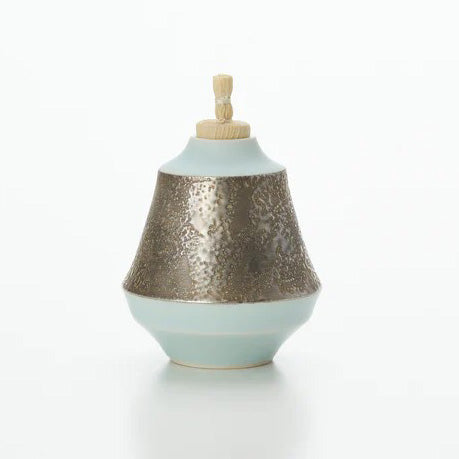
This piece is a "Blue and White Porcelain with Silver Glaze" by Matsukawa Kazuhiro. With a diameter of 6.4cm and a height of 9.1cm, it is easy to handle and neatly embodies the clear glaze of the blue and white porcelain, the subtle luster of the silver glaze, and the "beauty of movement" inherent in the tool known as a "Furidashi." When placed on a shelf, it stands dignified as a still life, and when picked up, it naturally straightens its back with a light sense of tension. This is the kind of piece it is.
I. The status of the prop called "Sinking" - How to handle "small amounts" beautifully
A furidashi is a small container used in the tea ceremony, and is a tool for handling small amounts of things cleanly and beautifully . The contents may vary depending on the occasion, style, and taste, but the common requirements are that it should not be "put out too much," "not be messy," and "make the movements of the hand look beautiful."
This piece perfectly embodies the rationality of its form in fulfilling these requirements. The bulge of the body guides the hand to rest comfortably, and the flow from the rim to the stopper naturally draws the eye upward. The furidashi may appear to play a supporting role, but in fact it is a tool used to regulate breathing during the tea ceremony. Matsukawa's work never exaggerates this role, but rather enhances it as a sense of tranquility.
II. Glaze Tone of Blue-and-White Porcelain: A Transparency Between "White" and "Blue"
Blue-and-white porcelain is somewhere between the cleanliness of white porcelain and a hint of celadon. It's not pure white, but it's not blue either. When it catches the light, the glaze layer becomes slightly transparent, creating a quiet depth, like peering into the depths of water .
As can be seen from the photograph, the shadows on the surface of this pale blue porcelain piece flow softly, keeping the outline smooth. This not only gives the piece a "refined" appearance, but also allows it to blend in with the light of a tea ceremony (light through a shoji screen or soft lighting at night). The elegance of the piece as a tool is evident from the serenity of the glaze itself.
III. The Ginsai "Scenery" - Not the brilliance of metal, but the lingering light
The silver glaze applied to the upper part of the body is not merely decorative, but acts as a boundary that changes the atmosphere of the vessel.** In contrast to the calm surface of the pale blue porcelain, the silver glaze has a subtle fluctuation, and its brightness changes slightly depending on how the light hits it.
What's important here is that the silver glaze is not used to create a flashy look, but rather to create a calm, lingering glow. Silver glaze is a technique that changes its appearance over time, and depending on how it is used and the environment, it can deepen in luster or take on a slightly more subdued patina. This change can also be seen as part of the "scenery of time" that is so beloved by the tea ceremony. It has a beauty that grows and develops, not just with the shine of a new piece.
IV. Key points of the design: the firmness of the torso, the tightness of the shoulders, and the presence of the stopper
The appeal of this design is its very clear silhouette.
Torso tension : Stabilizes the grip in the palm of your hand and makes handling smooth.
Tight shoulders : The center of gravity is visually raised, and the bowl as a whole does not appear stretched out.
The appearance of the wooden stopper : The warmth of the wood is added to the stillness of the ceramic, making it seem more real as a tool. The presence of "wood," which is neither metal nor ceramic, makes the gesture of the object in hand more human.
Furthermore, the opening is neatly constructed and the boundary line (the line where the lid joins) is clearly defined, making the closed vessel beautiful as well. The closed vessel is already a complete sight even before it is used - this is a crucial beauty of a small vessel.
V. Combination Ideas - Based on a tranquil tone, adding a seasonal touch
The combination of blue and white porcelain and silver glaze allows for a wide range of combinations, but is not too bold, so it does not interfere with the dignity of other utensils.
For example, the coolness of the pale blue porcelain shines in spring and summer, while the calmness of the silver glaze blends in with the light of autumn and winter. When you want to create a cool feeling in any season, place the pale blue porcelain side, and conversely, when you want to create a sharper look, place the silver glaze side -- one of the charms of this piece is that its appearance changes depending on how it is placed.
summary
Kazuhiro Matsukawa's "Blue and White Porcelain Silver Glaze" is a small piece that evokes a sense of tranquility with a touch of elegance , layered with a silver glaze over the clear glaze of the blue and white porcelain. The inherent function of the silver glaze, a tool called a silver glaze, is complemented by the rationality of the design and the lingering quality of the material, making it a piece that breathes well in any space, whether in use or on display.
The smaller the vessel, the less room for deception. This piece directly responds to this rigor, possessing a density that exceeds its dimensions.
Biography
1977 Born in Kawachinagano, Osaka Prefecture
1998 Graduated from Nara College of Arts, Ceramic Art Course
2000 Graduated from Nara College of Arts
2001 Graduated from Kyoto Prefectural Pottery Technical College and studied under Takahiro Kondo
2006 Independent and opened a kiln in Kawachinagano City
Major solo exhibitions and exhibitions
2007 Kyoto Prefecture Fine Arts and Crafts New Artists Selection Exhibition (Kyoto Museum)
Two-person exhibition (Matsuzakaya Nagoya Art Gallery/Nagoya)
Solo exhibition (Kyoto Takashimaya Art and Craft Salon/Kyoto)
2008 Solo Exhibition (Campanule/Chiba)
Solo exhibition (Paramita Museum Small Gallery/Mie)
2009 Solo Exhibition (Gallery Espace/Nagoya)
2010 Solo Exhibition (Sapporo Mitsukoshi Art Gallery/Hokkaido)
Solo exhibition (Matsuzakaya Nagoya Art Gallery/Nagoya)
Solo exhibition (Alpark Tenmaya Art Gallery/Hiroshima)
2011 Solo Exhibition (Ceramics Gallery Furyo/Osaka) ('07)
2012 Solo Exhibition (Gallery Okumura/Tokyo) ('07 '09)
2013 Solo Exhibition (Lovely Hall 20th Anniversary Event/Osaka)
2014 Solo Exhibition (Tenmaya Hiroshima Hatchobori Art Gallery/Hiroshima) ('11)
2016 Solo Exhibition (Tenmaya Fukuyama Art Gallery/Hiroshima) ('08 '12)
Three-person exhibition (Hakata Hankyu Muse/Fukuoka)
2017 Solo Exhibition (Pinacotheca / Tokyo) ('14 '15)
Solo exhibition (Tenmaya Okayama Art Gallery/Okayama) ('08)
Solo exhibition (Atelier Hiro/Osaka)
2018 Solo Exhibition (Nihonbashi Mitsukoshi Main Store Art Gallery/Tokyo)
Solo exhibition (Takashimaya Osaka Gallery NEXT/Osaka) ('08 '11 '15)
2020 Solo Exhibition (Hana Asagi/Tokyo)
2021 Solo Exhibition (Gallery Tachibana/Nara) ('15 '17 '19)
2022 Two-person exhibition (Hana Asagi/Tokyo)
2023 Two-person exhibition (Atelier Hiro/Osaka)
2025 Two-person exhibition (Hana Asagi/Tokyo)
Solo exhibition (Midorigaoka Museum of Art/Nara)
Awards
36th Japan Traditional Crafts Kinki Exhibition (Osaka Prefecture Board of Education Award)
55th Japan Traditional Crafts Exhibition (Japan Crafts Association President's Award)
Public Collection
Midorigaoka Museum of Art
Share

-
[I will send it to you quickly and carefully]
We carefully package each product in a way that suits it best.
Also, delivery times vary depending on the piece (vessel, etc.).
Items that already come with a box will be shipped within 1-3 days of the order date.
For items that require a box to be made after your order, it will take approximately 30 days for production to be completed and then shipped.
In either case, once we have confirmed your order, we will contact you by email to inform you of the delivery date.
-
[Requests when purchasing pottery]
Even products that look the same may differ slightly in color, shape, size, etc.
The way the glaze is used, the power of the kiln, the firing method, the season, and the humidity also affect the appearance of the pottery.
Please understand the individuality of each piece of pottery and enjoy the unique warmth of handmade.