


White porcelain incense burner by Kazuhiro Matsukawa
White porcelain incense burner by Kazuhiro Matsukawa
Couldn't load pickup availability
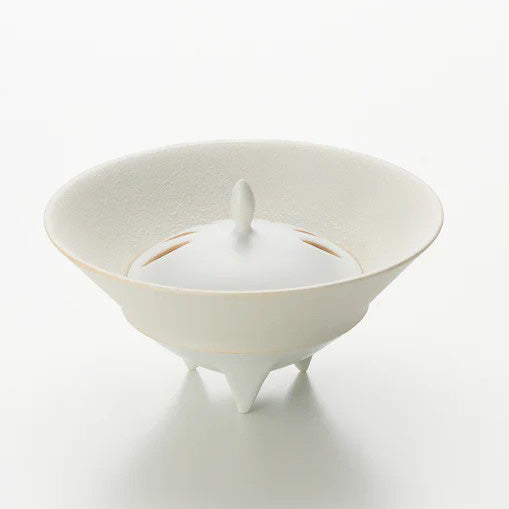
White porcelain incense burner by Kazuhiro Matsukawa (diameter: 15.4cm, height: 8.9cm)
--"In the silence of white, the path of fragrance opens up. A tripod sets the shape of purity afloat."
Ⅰ Incense vessels: vessels from the invisible world
An incense burner is not only a tool for burning incense, but also a vessel that regulates the flow of the invisible fragrance as a "place." Incense rises and disappears, but that fleeting presence conveys the dignity of the room, the changing of the seasons, and the host's thoughtfulness.
This piece, "White Porcelain Incense Burner," fulfills its function of dispensing incense, while at the same time possessing a presence that changes the density of the space it is placed in . The silence of the white porcelain absorbs the colors and textures of its surroundings, and the "preparation of silence" begins even before the incense is released.
II. The Beauty of White Porcelain: White is the Most Eloquent and the Most Ascetic
2-1 Depth of White: Porcelain Surface that Captures Light
The white of this piece is not simply a uniformly bright white. The porcelain surface softly diffuses light , and the shadows shift smoothly according to the gradient of the surface, creating a subtle depth within the tranquility. Because white porcelain has little color information, the slight differences in shape and surface directly express the piece's expression. Rather than treating white as "colorless," Matsukawa Kazuhiro sees it as a material for designing the quality of light , crystallizing a rich tranquility on the vessel.
2-2 A very faint scene appears on the rim
The faint pattern that appears around the rim (a fluctuation caused by firing) maintains the tension of the white porcelain while giving the vessel a slight warmth. It is not completely pure, but only a trace of the flame and the hand remains. This "slight fluctuation" creates an evocative sense of wabi , a style befitting a tool like an incense burner.
III. Shape and Design: Giving shape to the incense path
3-1 The floating sensation created by the tripod: a structure for purity
A distinctive feature of this piece is that the tripod slightly raises the vessel, lifting it off the floor. This gives the incense vessel a "layer of purity" both visually and functionally. The scent of incense is most beautiful when it rises quietly from a low position. The tripod is not merely a design element; it also gives the vessel a sense of elevation, a necessary element for the act of burning incense .
3-2 Openwork on the lid: To ensure the incense stands out in a balanced manner
The fire shed, which is set into the interior, has radial openwork. It is not enough for the incense to spray out forcefully; it is important that it rises quietly, yet surely and evenly . The rhythm of the openwork regulates the flow of the fragrance, gently tuning the speed and intensity at which the incense spreads through the space. It can be said that the composition presents the "pathway" of the incense itself as a design.
3-3 The shape of the knob: A single upward point tightens the whole piece
The central knob stands out as a small protrusion reminiscent of a bud or drop, giving the white world an "upward will." This single point connects the expanse of the vessel (horizontal) with the rising of the incense (vertical), visualizing its meaning as an incense vessel.
IV. Resonating with History: The Lineage of White Porcelain and the "White" of the Tea Ceremony
White porcelain is established as a symbol of purity and elegance in the history of Chinese ceramics, and has also earned a unique place in the Japanese tea ceremony. White is not flashy, but functions as a power to organize space . Black creates tension, and white allows breathing—among the utensils, this piece can become the "main character of the white space." The space is already clear even before the fragrance rises. This clarity is the aesthetic of white porcelain.
V. About the artist - Kazuhiro Matsukawa Biography, exhibition history, and awards
Kazuhiro Matsukawa studied ceramics at Nara College of Arts and Music, and after graduating from the Kyoto Prefectural Pottery Technical College, he studied under Takahiro Kondo . In 2006, he went independent and opened a kiln in Kawachinagano City. Since then, he has held numerous solo exhibitions, including at department stores and art museums, and has built a solid reputation, winning the Japan Crafts Council President's Award at the 55th Japan Traditional Crafts Exhibition. This work beautifully embodies his approach to honing the precision of form and rationality of use in white porcelain, the most unmistakable material.
Biography
1977 Born in Kawachinagano, Osaka Prefecture
1998 Graduated from Nara College of Arts, Ceramic Art Course
2000 Graduated from Nara College of Arts
2001 Graduated from Kyoto Prefectural Pottery Technical College and studied under Takahiro Kondo
2006 Independent and opened a kiln in Kawachinagano City
Major solo exhibitions and exhibitions
2007 Kyoto Prefecture Fine Arts and Crafts New Artists Selection Exhibition (Kyoto Museum)
Two-person exhibition (Matsuzakaya Nagoya Art Gallery/Nagoya)
Solo exhibition (Kyoto Takashimaya Art and Craft Salon/Kyoto)
2008 Solo Exhibition (Campanule/Chiba)
Solo exhibition (Paramita Museum Small Gallery/Mie)
2009 Solo Exhibition (Gallery Espace/Nagoya)
2010 Solo Exhibition (Sapporo Mitsukoshi Art Gallery/Hokkaido)
Solo exhibition (Matsuzakaya Nagoya Art Gallery/Nagoya)
Solo exhibition (Alpark Tenmaya Art Gallery/Hiroshima)
2011 Solo Exhibition (Ceramics Gallery Furyo/Osaka) ('07)
2012 Solo Exhibition (Gallery Okumura/Tokyo) ('07 '09)
2013 Solo Exhibition (Lovely Hall 20th Anniversary Event/Osaka)
2014 Solo Exhibition (Tenmaya Hiroshima Hatchobori Art Gallery/Hiroshima) ('11)
2016 Solo Exhibition (Tenmaya Fukuyama Art Gallery/Hiroshima) ('08 '12)
Three-person exhibition (Hakata Hankyu Muse/Fukuoka)
2017 Solo Exhibition (Pinacotheca / Tokyo) ('14 '15)
Solo exhibition (Tenmaya Okayama Art Gallery/Okayama) ('08)
Solo exhibition (Atelier Hiro/Osaka)
2018 Solo Exhibition (Nihonbashi Mitsukoshi Main Store Art Gallery/Tokyo)
Solo exhibition (Takashimaya Osaka Gallery NEXT/Osaka) ('08 '11 '15)
2020 Solo Exhibition (Hana Asagi/Tokyo)
2021 Solo Exhibition (Gallery Tachibana/Nara) ('15 '17 '19)
2022 Two-person exhibition (Hana Asagi/Tokyo)
2023 Two-person exhibition (Atelier Hiro/Osaka)
2025 Two-person exhibition (Hana Asagi/Tokyo)
Solo exhibition (Midorigaoka Museum of Art/Nara)
Awards
36th Japan Traditional Crafts Kinki Exhibition (Osaka Prefecture Board of Education Award)
55th Japan Traditional Crafts Exhibition (Japan Crafts Association President's Award)
Public Collection
Midorigaoka Museum of Art
summary
The white porcelain incense burner by Matsukawa Kazuhiro is a masterpiece that perfectly combines the functional beauty of burning incense with the serenity of white porcelain. The tripod creates a floating feeling, the openwork fire sill balances the fragrance, and the white color clarifies the space. Simply placing it at a tea ceremony will not only bring about a sense of incense, but will also quietly harmonize the atmosphere and gently open the senses of guests.
Share


-
[I will send it to you quickly and carefully]
We carefully package each product in a way that suits it best.
Also, delivery times vary depending on the piece (vessel, etc.).
Items that already come with a box will be shipped within 1-3 days of the order date.
For items that require a box to be made after your order, it will take approximately 30 days for production to be completed and then shipped.
In either case, once we have confirmed your order, we will contact you by email to inform you of the delivery date.
-
[Requests when purchasing pottery]
Even products that look the same may differ slightly in color, shape, size, etc.
The way the glaze is used, the power of the kiln, the firing method, the season, and the humidity also affect the appearance of the pottery.
Please understand the individuality of each piece of pottery and enjoy the unique warmth of handmade.