

Blue and white porcelain Hiryu porcelain bowl Kazuhiro Matsukawa
Blue and white porcelain Hiryu porcelain bowl Kazuhiro Matsukawa
Couldn't load pickup availability
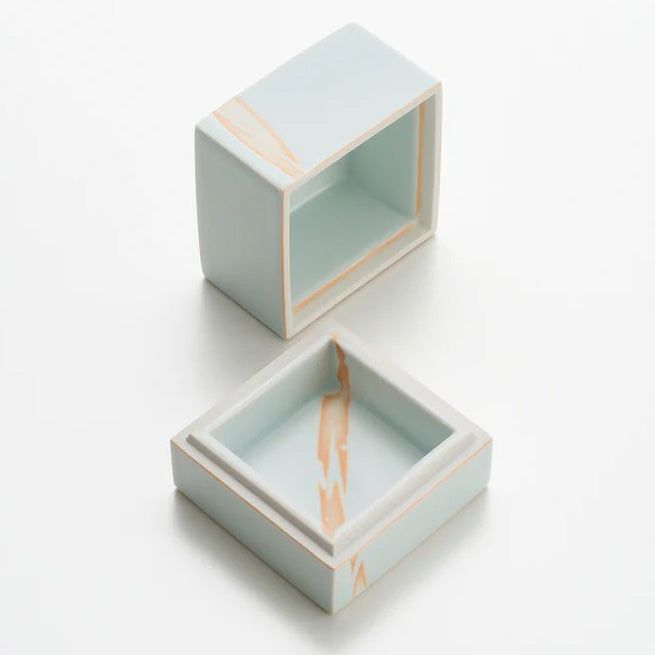
Blue and white porcelain box with red flow design by Kazuhiro Matsukawa (Φ: 7.9cm H: 7.6cm)
-- "A stream of scarlet breathes into the still pale blue water. Every time you open the lid, the scenery changes in this ceramic box."
Ⅰ The Ceramic Box Opening and Closing Ceremony
A ceramic box is not only a container for storing things, but also a tool that transforms the act of opening and closing itself into beauty . The tension at the moment the lid is closed, the release at the moment it is removed. Even before what is stored inside, the box plays a role in changing the atmosphere.
This "Blue and White Porcelain Scarlet Ceramic Box" has a neat rise and a precise joint between the lid and the body, making it feel very quiet when you hold it in your hand. Even the sound is modest, and the movement itself becomes a sign of courtesy. This is why the spirit of the tea ceremony naturally resides in this small box.
II. Blue-and-white porcelain: Clearer than white, softer than blue
2-1 Porcelain skin that collects light: A tranquil, unclouded white
The appeal of pale blue porcelain lies not in the strength of the color itself, but in the elegance of how it catches light . By incorporating the purity of white porcelain into the base tone, and adding a touch of pale blue, the vessel stands out as "clear" rather than "cold."
Shadows shift smoothly along the gradient of the surface, and the gradations that converge at the corners highlight the precision of the form. With less unnecessary information, the viewer's senses are sharpened, and the density of the stillness increases.
2-2 The shape speaks: A presence that transcends the box's dimensions
The palm-sized size is like a condensed stage. Its small size is not modest, but rather a focus. The shape is clean, the contours clear, and the space is brought to order simply by being placed there —the spatial harmony of blue-and-white porcelain is more clearly expressed in the form of a box.
III. Hinagare - A "scent of crimson" running through still water
3-1 Scarlet is not a decoration, but a part of the scenery
The greatest appeal of this piece is the flow of scarlet that runs continuously from surface to surface across the pale blue porcelain surface. The scarlet does not scream red, but rather gently but surely injects warmth .
The flow does not stay in one place, but flows from the top of the lid to the side, and then over the gap to the body. This is what makes a box so interesting. When closed, the lines are continuous, but when opened, the lines are divided. In other words, a box is a vessel with a changing appearance.
3-2 Flames and Handprints: The Sophistication of Designing Chance
The beauty of Hiryu is not simply a "pattern," but rather the way the firing process remains intact. Shades, bleeding, fading, thin branches - these fluctuations give a slight breath to the ascetic orderliness of the pale blue porcelain.
If it is too tidy, it will die, and if it is too rough, it will lose its elegance. At that boundary, Kazuhiro Matsukawa exercises the minimum amount of control to turn chance into beauty . This is why scarlet is vivid, but never vulgar.
IV. The structural beauty of the lid and body – the tension created by the “joint line”
The beauty of the box is not limited to the top surface of the lid. The line at the joint tightens the vessel. The thin division visible in the photo acts as a functional boundary as well as a visual horizon .
The diagonal flow (movement) of the red flow intersects with the horizontal line (stillness) of the joint, giving the vessel a unique appearance. Moving your eyes further inward, a pale blue still water spreads across the interior, creating a "space in the depths" that is different from the exterior. It is the space that encases the items stored inside, and the purity of the space itself is valuable - the essence of the ceramic box is neatly displayed here.
V. Combinations and Uses - The Benefits of Adding a Point of "Scarlet"
This piece is based on the tranquility of pale blue, so it can be combined with a wide range of items, yet the addition of a single scarlet piece brings out a sense of the season.
For example, in early spring, when the sun shines faintly into the still-cold air, pale blue evokes images of thin ice and spring mist, while scarlet is a sign of young sunlight and flowers. In autumn and winter, pale blue porcelain conveys clarity, while scarlet conveys the warmth of the hearth.
It can be used to store incense, small sweets, or other decorative items. It can also be used to store empty space. Boxes are not just there to protect their contents, but also to slow down the mind - this piece is one of the most beautiful answers to that question.
summary
The blue-and-white porcelain box with its scarlet flow creates a scene in the palm of your hand, where the pure silence of the blue-and-white porcelain is given a ray of life by the scarlet. The scarlet flow runs continuously across the lid and body, coming together when the box is closed and separating when it is opened, bringing beauty to the very act of holding the box.
Purity and warmth, stillness and movement, space and presence. These elements coexist in a small vessel, and simply placing it there changes the density of the space - this is a neat and poetic ceramic box that is unique to Kazuhiro Matsukawa.
Biography
1977 Born in Kawachinagano, Osaka Prefecture
1998 Graduated from Nara College of Arts, Ceramic Art Course
2000 Graduated from Nara College of Arts
2001 Graduated from Kyoto Prefectural Pottery Technical College and studied under Takahiro Kondo
2006 Independent and opened a kiln in Kawachinagano City
Major solo exhibitions and exhibitions
2007 Kyoto Prefecture Fine Arts and Crafts New Artists Selection Exhibition (Kyoto Museum)
Two-person exhibition (Matsuzakaya Nagoya Art Gallery/Nagoya)
Solo exhibition (Kyoto Takashimaya Art and Craft Salon/Kyoto)
2008 Solo Exhibition (Campanule/Chiba)
Solo exhibition (Paramita Museum Small Gallery/Mie)
2009 Solo Exhibition (Gallery Espace/Nagoya)
2010 Solo Exhibition (Sapporo Mitsukoshi Art Gallery/Hokkaido)
Solo exhibition (Matsuzakaya Nagoya Art Gallery/Nagoya)
Solo exhibition (Alpark Tenmaya Art Gallery/Hiroshima)
2011 Solo Exhibition (Ceramics Gallery Furyo/Osaka) ('07)
2012 Solo Exhibition (Gallery Okumura/Tokyo) ('07 '09)
2013 Solo Exhibition (Lovely Hall 20th Anniversary Event/Osaka)
2014 Solo Exhibition (Tenmaya Hiroshima Hatchobori Art Gallery/Hiroshima) ('11)
2016 Solo Exhibition (Tenmaya Fukuyama Art Gallery/Hiroshima) ('08 '12)
Three-person exhibition (Hakata Hankyu Muse/Fukuoka)
2017 Solo Exhibition (Pinacotheca / Tokyo) ('14 '15)
Solo exhibition (Tenmaya Okayama Art Gallery/Okayama) ('08)
Solo exhibition (Atelier Hiro/Osaka)
2018 Solo Exhibition (Nihonbashi Mitsukoshi Main Store Art Gallery/Tokyo)
Solo exhibition (Takashimaya Osaka Gallery NEXT/Osaka) ('08 '11 '15)
2020 Solo Exhibition (Hana Asagi/Tokyo)
2021 Solo Exhibition (Gallery Tachibana/Nara) ('15 '17 '19)
2022 Two-person exhibition (Hana Asagi/Tokyo)
2023 Two-person exhibition (Atelier Hiro/Osaka)
2025 Two-person exhibition (Hana Asagi/Tokyo)
Solo exhibition (Midorigaoka Museum of Art/Nara)
Awards
36th Japan Traditional Crafts Kinki Exhibition (Osaka Prefecture Board of Education Award)
55th Japan Traditional Crafts Exhibition (Japan Crafts Association President's Award)
Public Collection
Midorigaoka Museum of Art
Share


-
[I will send it to you quickly and carefully]
We carefully package each product in a way that suits it best.
Also, delivery times vary depending on the piece (vessel, etc.).
Items that already come with a box will be shipped within 1-3 days of the order date.
For items that require a box to be made after your order, it will take approximately 30 days for production to be completed and then shipped.
In either case, once we have confirmed your order, we will contact you by email to inform you of the delivery date.
-
[Requests when purchasing pottery]
Even products that look the same may differ slightly in color, shape, size, etc.
The way the glaze is used, the power of the kiln, the firing method, the season, and the humidity also affect the appearance of the pottery.
Please understand the individuality of each piece of pottery and enjoy the unique warmth of handmade.