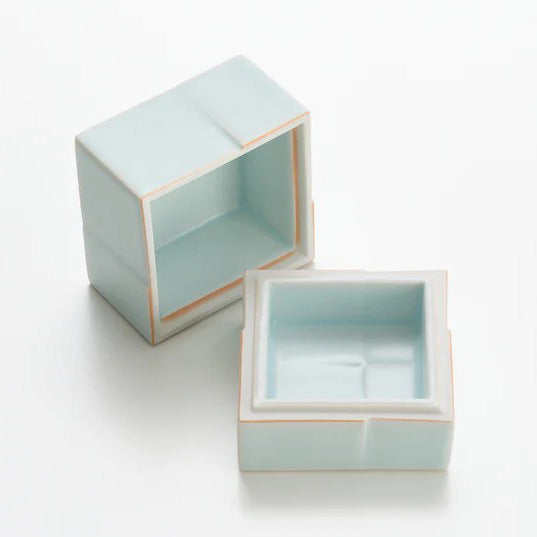


Blue and white porcelain box by Kazuhiro Matsukawa (Φ: 7.4cm H: 7.9cm)
-- "A pale blue cube contains a blank space. The divided surfaces create a lattice of tranquility."
Ⅰ A small alcove called a ceramic box
A ceramic box is not just a container for storing things, but also a tool that changes the air with the action of opening and closing it . The tension that is created the moment the lid is closed, and the space that appears the moment it is removed. There, the idea of "ma" (space) that has been valued in the tea ceremony is embodied.
This work, "Blue and White Porcelain Box," is a palm-sized piece that condenses the clarity of blue and white porcelain and the intricate design of its form. Just by placing it, the space is brought into order, and picking it up brings calm and refinement to one's movements - the essence of the box is neatly embodied in this work.
II. The Beauty of Blue-and-White Porcelain: "Clearer than white, softer than blue"
2-1 A hint of pale blue: not the color, but the quality of light
The appeal of pale blue porcelain lies not in the strength of its color, but in the delicate quality with which it absorbs light . By incorporating the purity of white porcelain into the base, the vessel stands out as "clear" rather than cold.
The shadows change smoothly according to the angle of the surface, and the gradation that gathers at the corners makes the outline of the vessel appear softer and deeper.
2-2 Magnetic Silence: The less information you have, the more calm your mind becomes
The less decoration there is, the more the viewer will listen closely to the smallest differences. The pale blue porcelain in this work is precisely the material for that silence. The absence of conspicuous colors or patterns allows the precision of the form, the tension of the surfaces, and the lines of the joints to emerge as expressive features, quietly enhancing the density of the space.
III. The core of the design: surfaces divided like a lattice
3-1 Quiet rhythm created by dividing lines
What characterizes this piece is the ridges and grooves that separate the surfaces within its cubic volume. A cross-shaped section appears on the top surface, and the side surfaces continue to show the same neat divisions.
This is not decoration, but the breath of the form. Rather than relying on a plain flat surface, slight undulations give the box a "quiet rhythm," preventing it from becoming monotonous even though it is small. The shadows rearrange depending on the viewing angle, and the vessel quietly changes its appearance within itself.
3-2 The difficulty of being minimal
The square form and division of the surfaces immediately reveal any slight distortion or imperfection in precision. Under these strict conditions, Matsukawa Kazuhiro has managed to create a neat yet lively shape without compromising the contours or making them rigid. The more ascetic the design, the more the artist's skill is imprinted directly on the vessel - this piece is a testament to that.
IV. The lid and body – the lines of the joint create a sense of unity
4-1 The joint creates a "single horizontal line"
A thin horizontal line appears at the boundary between the lid and the body. This horizontal line tightens the center of gravity of the vessel and gives it an elegant appearance. Furthermore, a very pale scarlet (a soft orange color that comes from the firing process) is faintly cast along this line, adding a slight warmth to the pure blue-and-white porcelain.
It is not a strong color, but it gives off the impression that the box is not completely pure , and adds a layer of depth to the box's appearance.
4-2 The inner "pale blue space"
When the lid is removed, a pale blue space appears within. If the outside is the "front" that organizes the space, the inside is the "back" that quietly encases the items inside. It can hold anything - incense, sugar candy, a small seal, tea ceremony props - but at the same time, it can also be complete without putting anything inside. A ceramic box can also sometimes be a container that stores empty space itself .
V. Combination - A box that focuses on "purity"
This piece, based on the clear blue-and-white porcelain, can be combined with a wide range of items, while naturally elevating the status of the space it is placed in. When placed on a black shelf or dark floorboard, its outline stands out, and when combined with white cloth or Japanese paper, its purity is enhanced.
In terms of the seasons, it goes well with thin ice, spring haze, and clear air - such a "transparent seasonal feeling" and can become the "main character of the white space" among the tools.
summary
The blue and white porcelain box is a masterpiece that has a rhythmic interior, based on the clear and tranquil nature of blue and white porcelain, with the grid-like shadows created by the division of the surface. A single line at the joint tightens the appearance, and the act of opening and closing it is a gesture of courtesy.
Small and neat, but by no means inorganic - a ceramic box that holds a tranquil architecture in the palm of your hand.
Biography
1977 Born in Kawachinagano, Osaka Prefecture
1998 Graduated from Nara College of Arts, Ceramic Art Course
2000 Graduated from Nara College of Arts
2001 Graduated from Kyoto Prefectural Pottery Technical College and studied under Takahiro Kondo
2006 Independent and opened a kiln in Kawachinagano City
Major solo exhibitions and exhibitions
2007 Kyoto Prefecture Fine Arts and Crafts New Artists Selection Exhibition (Kyoto Museum)
Two-person exhibition (Matsuzakaya Nagoya Art Gallery/Nagoya)
Solo exhibition (Kyoto Takashimaya Art and Craft Salon/Kyoto)
2008 Solo Exhibition (Campanule/Chiba)
Solo exhibition (Paramita Museum Small Gallery/Mie)
2009 Solo Exhibition (Gallery Espace/Nagoya)
2010 Solo Exhibition (Sapporo Mitsukoshi Art Gallery/Hokkaido)
Solo exhibition (Matsuzakaya Nagoya Art Gallery/Nagoya)
Solo exhibition (Alpark Tenmaya Art Gallery/Hiroshima)
2011 Solo Exhibition (Ceramics Gallery Furyo/Osaka) ('07)
2012 Solo Exhibition (Gallery Okumura/Tokyo) ('07 '09)
2013 Solo Exhibition (Lovely Hall 20th Anniversary Event/Osaka)
2014 Solo Exhibition (Tenmaya Hiroshima Hatchobori Art Gallery/Hiroshima) ('11)
2016 Solo Exhibition (Tenmaya Fukuyama Art Gallery/Hiroshima) ('08 '12)
Three-person exhibition (Hakata Hankyu Muse/Fukuoka)
2017 Solo Exhibition (Pinacotheca / Tokyo) ('14 '15)
Solo exhibition (Tenmaya Okayama Art Gallery/Okayama) ('08)
Solo exhibition (Atelier Hiro/Osaka)
2018 Solo Exhibition (Nihonbashi Mitsukoshi Main Store Art Gallery/Tokyo)
Solo exhibition (Takashimaya Osaka Gallery NEXT/Osaka) ('08 '11 '15)
2020 Solo Exhibition (Hana Asagi/Tokyo)
2021 Solo Exhibition (Gallery Tachibana/Nara) ('15 '17 '19)
2022 Two-person exhibition (Hana Asagi/Tokyo)
2023 Two-person exhibition (Atelier Hiro/Osaka)
2025 Two-person exhibition (Hana Asagi/Tokyo)
Solo exhibition (Midorigaoka Museum of Art/Nara)
Awards
36th Japan Traditional Crafts Kinki Exhibition (Osaka Prefecture Board of Education Award)
55th Japan Traditional Crafts Exhibition (Japan Crafts Association President's Award)
Public Collection
Midorigaoka Museum of Art