


Blue and white porcelain silver bowl Kazuhiro Matsukawa
Blue and white porcelain silver bowl Kazuhiro Matsukawa
Couldn't load pickup availability
Blue and white porcelain silver-glazed tea bowl by Kazuhiro Matsukawa (Φ14.7×H6.3cm)
-- "The silver forms the edge, and the blue forms the space between the two. A bowl that exudes serenity from its rim."
I. My first impression of this tea bowl: the reversed composition of "silver on top, blue on bottom"
This work is composed of silver glaze that extends widely from the rim to the upper half, with the blue-and-white porcelain supporting the lower half .
In other words, the eye first touches the silver rim, then slides into the blue-and-white porcelain interior.The design gives a hint of elegance to the rim, which is extremely essential for a tea bowl .
The dimensions are Φ14.7cm, H6.3cm. It is slightly large, with a generous surface area, allowing the poured tea to gently unfold. The rim opens neatly, giving the bowl a light appearance. The base is tight, giving the bowl a stable, taut feel, neither floating nor sinking.
II. The texture of Ginsai: like frost, delicate and radiant
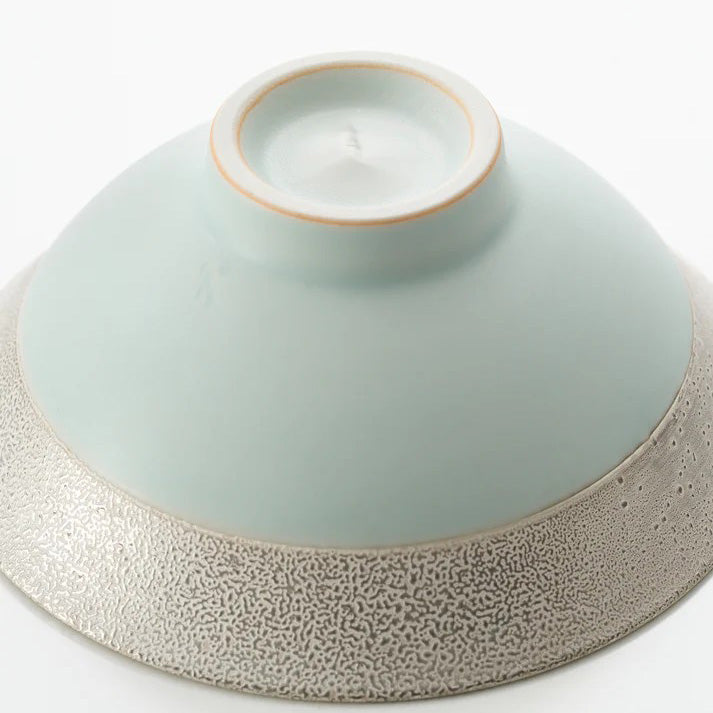
The silver glaze that spreads around the rim is not a mirror-like silver, but rather has a texture similar to frost pillars or the surface of stone, with fine particles running densely . In close-up photographs, countless fine undulations are visible, softly dispersing the light.
This silver glaze is not "brightly shining" but quietly bright . It changes color to white or lead depending on the light of the tea room or natural light, and acts like a "thin film" that reflects the seasons and time.
Even more striking are the tiny holes and dots that appear on the edges of the silver glaze. These do not appear to be harsh, but rather like breathing holes that prevent the piece from becoming too homogenous . The rawness of the ceramic material remains on the metallic surface, instantly making the piece more poetic.
III. The lower half of the pale blue porcelain: The volume of water supporting the bowl
The pale blue porcelain that occupies the lower half of the piece creates a pale blue layer that calms the center of gravity of the vessel.
If the silver glaze represents "light spreading outward," then the pale blue porcelain represents "water sinking inward." This contrast gives the tea bowl a spiritual depth .
The glaze is not cloudy, leaning towards white, but there is a definite hint of blue. When you hold it in your hand, the texture of the silver glaze gives information to your fingers, while the blue-and-white porcelain surface fits smoothly into your palm. The contrast in sensations is also part of the charm of this tea bowl.
IV. The calmness of the prospect: Matcha is not "shining" but "clear"
The inside is uniformly blue-and-white porcelain, with a faint circular shape visible in the center. This is the silent focal point when whisking matcha, and the movement of the tea whisk naturally converges here.
This blue is not meant to make the matcha look flashy, but rather to not overpower the green color and to allow the flavor and aroma to stand out .
The silver glaze around the rim makes customers first sense the light around the rim, and then their eyes fall to the blue inside.
The flow of your gaze itself creates the calmness necessary for a cup of tea.
V. Around the base: Thin lines give it a sense of dignity
Looking at the back, pale blue-white porcelain is quietly accumulated inside the foot, and a thin reddish (orange) line runs around the edge of the foot.
These lines are not merely decorative, but rather a finishing touch that balances the overall tension of the vessel. The silver glaze particles, the pale blue porcelain surface, and these thin lines create a three-layered rhythm that naturally elevates the vessel's elegance.
VI. Expressions during the tea ceremony: "The rim shines and the tea is clear"
This piece is particularly striking in a tea ceremony setting, because the moment the tea bowl is picked up, the silver rim is illuminated by the light and glows pale, before fading into a tranquil blue on the inside.
Before drinking, the guest touches the silver rim, and at the moment of drinking, they bring their mouth to the blue-and-white porcelain. In other words, this bowl is a tea bowl that gives a sense of elegance to the drinking rim and a margin of space for reflection .
It goes well with white sweets in winter, light main sweets in early spring, or cool summer combinations.It is not limited to a particular season, and its appearance changes depending on the lighting conditions, making it versatile and suitable for use all year round.
VII. Musubi - A tranquil design with silver edging
The clarity of the blue-and-white porcelain is layered with the grains of light of the silver glaze.
Even if the combination is the same, the moment the silver is placed on the rim instead of the body, the character of the tea bowl changes.
This piece first guides the gaze and movements of the viewer around the edge, then calms them down as they look out - a perfect vessel for tea.
Kazuhiro Matsukawa's blue and white porcelain is not just beautiful, it also has a warmth that calms the soul.
This silver glaze does not just shine, but also gives shape to the atmosphere.
Within the bowl, light and water subdue each other, deepening the sense of tranquility. This is a dignified and elegant blue-and-white porcelain silver-glazed tea bowl.
Biography
1977 Born in Kawachinagano, Osaka Prefecture
1998 Graduated from Nara College of Arts, Ceramic Art Course
2000 Graduated from Nara College of Arts
2001 Graduated from Kyoto Prefectural Pottery Technical College and studied under Takahiro Kondo
2006 Independent and opened a kiln in Kawachinagano City
Major solo exhibitions and exhibitions
2007 Kyoto Prefecture Fine Arts and Crafts New Artists Selection Exhibition (Kyoto Museum)
Two-person exhibition (Matsuzakaya Nagoya Art Gallery/Nagoya)
Solo exhibition (Kyoto Takashimaya Art and Craft Salon/Kyoto)
2008 Solo Exhibition (Campanule/Chiba)
Solo exhibition (Paramita Museum Small Gallery/Mie)
2009 Solo Exhibition (Gallery Espace/Nagoya)
2010 Solo Exhibition (Sapporo Mitsukoshi Art Gallery/Hokkaido)
Solo exhibition (Matsuzakaya Nagoya Art Gallery/Nagoya)
Solo exhibition (Alpark Tenmaya Art Gallery/Hiroshima)
2011 Solo Exhibition (Ceramics Gallery Furyo/Osaka) ('07)
2012 Solo Exhibition (Gallery Okumura/Tokyo) ('07 '09)
2013 Solo Exhibition (Lovely Hall 20th Anniversary Event/Osaka)
2014 Solo Exhibition (Tenmaya Hiroshima Hatchobori Art Gallery/Hiroshima) ('11)
2016 Solo Exhibition (Tenmaya Fukuyama Art Gallery/Hiroshima) ('08 '12)
Three-person exhibition (Hakata Hankyu Muse/Fukuoka)
2017 Solo Exhibition (Pinacotheca / Tokyo) ('14 '15)
Solo exhibition (Tenmaya Okayama Art Gallery/Okayama) ('08)
Solo exhibition (Atelier Hiro/Osaka)
2018 Solo Exhibition (Nihonbashi Mitsukoshi Main Store Art Gallery/Tokyo)
Solo exhibition (Takashimaya Osaka Gallery NEXT/Osaka) ('08 '11 '15)
2020 Solo Exhibition (Hana Asagi/Tokyo)
2021 Solo Exhibition (Gallery Tachibana/Nara) ('15 '17 '19)
2022 Two-person exhibition (Hana Asagi/Tokyo)
2023 Two-person exhibition (Atelier Hiro/Osaka)
2025 Two-person exhibition (Hana Asagi/Tokyo)
Solo exhibition (Midorigaoka Museum of Art/Nara)
Awards
36th Japan Traditional Crafts Kinki Exhibition (Osaka Prefecture Board of Education Award)
55th Japan Traditional Crafts Exhibition (Japan Crafts Association President's Award)
Public Collection
Midorigaoka Museum of Art
Share


-
[I will send it to you quickly and carefully]
We carefully package each product in a way that suits it best.
Also, delivery times vary depending on the piece (vessel, etc.).
Items that already come with a box will be shipped within 1-3 days of the order date.
For items that require a box to be made after your order, it will take approximately 30 days for production to be completed and then shipped.
In either case, once we have confirmed your order, we will contact you by email to inform you of the delivery date.
-
[Requests when purchasing pottery]
Even products that look the same may differ slightly in color, shape, size, etc.
The way the glaze is used, the power of the kiln, the firing method, the season, and the humidity also affect the appearance of the pottery.
Please understand the individuality of each piece of pottery and enjoy the unique warmth of handmade.