


Blue and white porcelain silver bowl Kazuhiro Matsukawa
Blue and white porcelain silver bowl Kazuhiro Matsukawa
Couldn't load pickup availability
Blue and white porcelain silver-glazed tea bowl by Kazuhiro Matsukawa (Φ14.4×H6.1cm)
-- "Blue water and silver skin. Two layers of tranquility in one bowl."
I. The scenery created by this tea bowl: the coexistence of clear and shining bowls
This tea bowl features the clear blue of the pale blue porcelain and the quiet brilliance of the silver glaze, clearly separated on the same vessel, yet mysteriously blending together naturally.
The appearance is a neat bowl shape, with a slightly open rim that maintains a sense of tension without widening too much. The cup has a large opening that beautifully shows off the surface of the matcha, but is not too deep, making it easy to handle and allowing for a light and easy-to-use brewing motion.
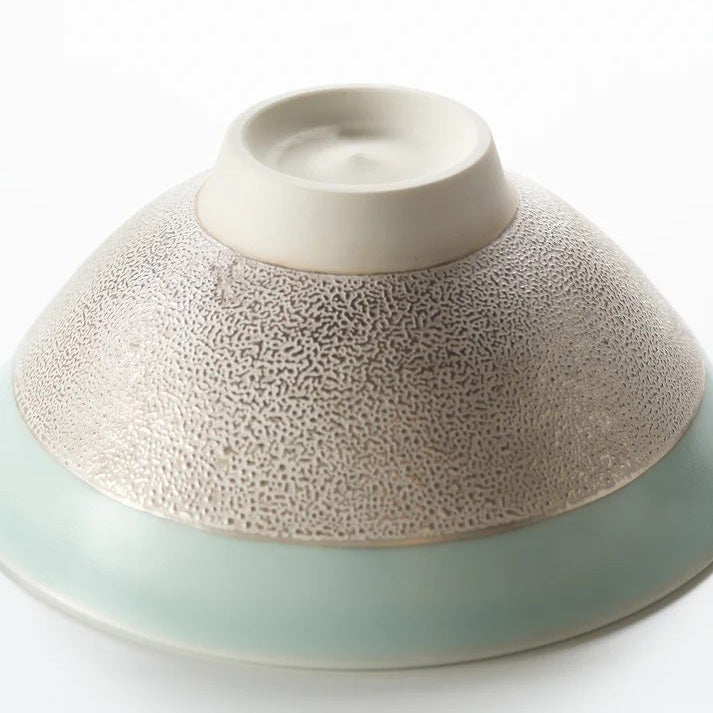
What is most distinctive about it is the blue-and-white porcelain on top and the silver-colored belt wrapped around the body .
The pale blue porcelain creates a sense of tranquility as the "color of water," while the silver glaze creates a sense of presence as the "skin of light." In other words, this bowl can be said to be one that changes the quality of the air, rather than its color.
II. The Prospects of Blue-and-White Porcelain: Not "White" but a Clear Blue
The inside is a soft, pale blue. As you can see from the photo, it lies in the exquisite realm of blue-and-white porcelain, which is "leaning towards white, yet still clearly blue."
Under light, it approaches a clean white, but when there is a slight shadow, a faint blue emerges. When you brew matcha, this blue doesn't stand out too much, but rather acts as a background that brings out the green of the matcha without clouding it .
Furthermore, a faint circular shape (a quiet outline reminiscent of the potter's wheel's marks) that appears in the center of the cup acts as a silent focal point. The movements of the tea whisk converge there, the bubbles settle, and the drinker's gaze is naturally drawn to the center.
The appeal of this blue-and-white porcelain is not its flashiness, but its design that leads the eye in a direction that brings peace of mind .
III. Silver Obi: Silver as a Fine Texture, Not a Metal
The silver glaze wrapped around the body is not a reflective silver like a mirror, but rather a silver with a fine texture like the surface of a stone or frost pillars . In a close-up photo, countless fine particles run densely across it, creating a uniform yet not monotonous "rough" appearance.
This texture is a type of silver glaze that gives information back to your hand the moment you touch it, and it is important that it conveys a sense of calm not only visually but also to the sense of touch .
The appearance of Ginsai changes depending on the angle of the light. At times it appears white, and at other times it sinks into a leaden hue. In other words, the belt around the body is not a fixed surface of color, but a "film of light" that breathes in response to the ambient light.
The light from the tea ceremony room, the natural light coming through the window, the lighting at night - under each set of conditions the bowl shows a different face, and each time it blends in with the atmosphere of the "here and now."
IV. The Beauty of Boundaries: The Tension of the "Line" that Separates Blue-and-White Porcelain and Silver Glaze
The clear surface of the pale blue porcelain and the texture of the silver glaze. The boundary between them is clear, yet not too rigid. This is where Kazuhiro Matsukawa's artistic sense is evident.
If the boundaries are vague, the vessel becomes scattered, but if the boundaries are too strong, the vessel becomes rigid. This work is somewhere in between, maintaining order while establishing a boundary that leaves a lingering impression .
Furthermore, at the bottom of the silver glaze, the end of the glaze appears as a slight line, creating a cohesive "belt."
This "band structure" tightens the vessel as a whole, making the blue of the inside appear clearer and the silver appear deeper. Rather than creating a strong contrast, the two colors subtly complement each other.
V. Cleanliness of the hills - Reliability as a tool
Looking at the back, the base is white and neatly trimmed, providing a stable seat. The edges of the base are also gently processed, making it easy to handle and less likely to catch on the touch.
Before being a vessel for appreciation, a tea bowl is a vessel for action. Picking it up, turning it, putting it down, wiping it - the smoothness of these actions determines its quality as a tool. This piece is not only beautiful in appearance, but also possesses the quiet practicality to withstand daily use.
VI. The allure of tea ceremony: A bowl with a clear green matcha color
This tea bowl is not the type that emphasizes the color of the matcha, but rather acts as a background that allows the green of the matcha to stand out naturally.
The blue-and-white porcelain on the inside does not cloud the green of the matcha, and the silver-colored band adds a "thickness of presence" to the outside.
In other words, while the drinker concentrates on the taste of the matcha, the silver texture speaks quietly in the hand, and the blue-and-white porcelain maintains a clear space before the eyes. This tea bowl perfectly balances taste, touch, and sight.
VII Conclusion - Sealing the blue and silver silence of water in one bowl
The pale blue porcelain is as clear as water, and the silver glaze is silent and filled with light.
Rather than simply juxtaposing the two, Matsukawa Kazuhiro has layered them as layers of tranquility on an everyday item such as a bowl .
When you pour matcha into the cup, the blue of the inside spreads softly like breathing, and the silver of the body deepens the outline of the atmosphere.
This tea bowl does not dominate the space with its splendor, but rather works to harmonize the space and calm people's minds.It is a dignified bowl that embodies the word "tranquility."
Biography
1977 Born in Kawachinagano, Osaka Prefecture
1998 Graduated from Nara College of Arts, Ceramic Art Course
2000 Graduated from Nara College of Arts
2001 Graduated from Kyoto Prefectural Pottery Technical College and studied under Takahiro Kondo
2006 Independent and opened a kiln in Kawachinagano City
Major solo exhibitions and exhibitions
2007 Kyoto Prefecture Fine Arts and Crafts New Artists Selection Exhibition (Kyoto Museum)
Two-person exhibition (Matsuzakaya Nagoya Art Gallery/Nagoya)
Solo exhibition (Kyoto Takashimaya Art and Craft Salon/Kyoto)
2008 Solo Exhibition (Campanule/Chiba)
Solo exhibition (Paramita Museum Small Gallery/Mie)
2009 Solo Exhibition (Gallery Espace/Nagoya)
2010 Solo Exhibition (Sapporo Mitsukoshi Art Gallery/Hokkaido)
Solo exhibition (Matsuzakaya Nagoya Art Gallery/Nagoya)
Solo exhibition (Alpark Tenmaya Art Gallery/Hiroshima)
2011 Solo Exhibition (Ceramics Gallery Furyo/Osaka) ('07)
2012 Solo Exhibition (Gallery Okumura/Tokyo) ('07 '09)
2013 Solo Exhibition (Lovely Hall 20th Anniversary Event/Osaka)
2014 Solo Exhibition (Tenmaya Hiroshima Hatchobori Art Gallery/Hiroshima) ('11)
2016 Solo Exhibition (Tenmaya Fukuyama Art Gallery/Hiroshima) ('08 '12)
Three-person exhibition (Hakata Hankyu Muse/Fukuoka)
2017 Solo Exhibition (Pinacotheca / Tokyo) ('14 '15)
Solo exhibition (Tenmaya Okayama Art Gallery/Okayama) ('08)
Solo exhibition (Atelier Hiro/Osaka)
2018 Solo Exhibition (Nihonbashi Mitsukoshi Main Store Art Gallery/Tokyo)
Solo exhibition (Takashimaya Osaka Gallery NEXT/Osaka) ('08 '11 '15)
2020 Solo Exhibition (Hana Asagi/Tokyo)
2021 Solo Exhibition (Gallery Tachibana/Nara) ('15 '17 '19)
2022 Two-person exhibition (Hana Asagi/Tokyo)
2023 Two-person exhibition (Atelier Hiro/Osaka)
2025 Two-person exhibition (Hana Asagi/Tokyo)
Solo exhibition (Midorigaoka Museum of Art/Nara)
Awards
36th Japan Traditional Crafts Kinki Exhibition (Osaka Prefecture Board of Education Award)
55th Japan Traditional Crafts Exhibition (Japan Crafts Association President's Award)
Public Collection
Midorigaoka Museum of Art
Share


-
[I will send it to you quickly and carefully]
We carefully package each product in a way that suits it best.
Also, delivery times vary depending on the piece (vessel, etc.).
Items that already come with a box will be shipped within 1-3 days of the order date.
For items that require a box to be made after your order, it will take approximately 30 days for production to be completed and then shipped.
In either case, once we have confirmed your order, we will contact you by email to inform you of the delivery date.
-
[Requests when purchasing pottery]
Even products that look the same may differ slightly in color, shape, size, etc.
The way the glaze is used, the power of the kiln, the firing method, the season, and the humidity also affect the appearance of the pottery.
Please understand the individuality of each piece of pottery and enjoy the unique warmth of handmade.