


Blue and white porcelain silver-glazed incense burner by Kazuhiro Matsukawa
Blue and white porcelain silver-glazed incense burner by Kazuhiro Matsukawa
Couldn't load pickup availability
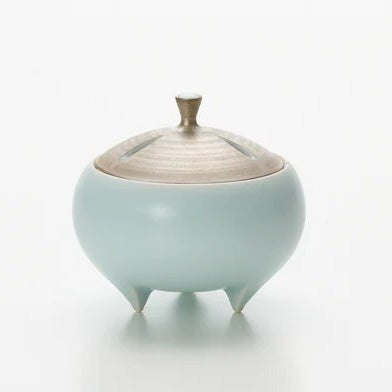
Blue-and-white porcelain silver-glazed incense burner by Kazuhiro Matsukawa (diameter: 7.1 cm, height: 6.6 cm)
-- "A pale blue in the palm of your hand, a single sliver of incense on a silver lid. This small vessel achieves the ultimate in 'density of silence.'"
Ⅰ The “smallest universe” of incense vessels
An incense burner is not only a tool for burning incense, but also a vessel that transforms the invisible scent into spatial order . In particular, for a small piece like this one, measuring 7.1cm in diameter and 6.6cm in height, even a flaw in the shape, texture, or function immediately disrupts the overall tension.
However, this incense burner by Matsukawa Kazuhiro is small enough to fit in the palm of your hand, yet it combines a structure that allows the incense to rise and a design that creates a tranquil atmosphere that helps the viewer to regulate their breathing, all with an astonishingly high level of density.
II. Blue-and-white porcelain: a clear blue deeper than "white"
The appeal of pale blue porcelain lies not simply in the beauty of its color, but in the gentle gradations it creates when exposed to light. The body of this piece is based on a rounded bulge, tapering slightly at the bottom and gently sloping down to three legs.
The pale blue glaze is not a cold blue, but a clear blue like the surface of water . Depending on the angle of the light, the pale blue may sink slightly deeper or suddenly become brighter. This subtle change creates a "tranquil expression" that is appropriate for vessels that handle the invisible substance of incense.
III. Silver-painted lid: Showing the incense outlet with a "faint light"
The silver glaze in this work is concentrated on the top part of the vessel (the lid), and the faint light of the silver adds a point of tension to the soft silence of the pale blue porcelain.
The lid has gentle, concentric wheel marks and a small, elegant central knob. Even more noteworthy is the narrow opening (openwork) in the lid. The more beautiful the incense, the more subtle, even, and quiet it rises, rather than erupting forcefully. In this piece, the "path of incense" is elegantly engraved into the silver-colored surface.
Silver reflects light, sometimes changing color depending on the angle from which it is viewed, sometimes softly dull - in other words, Ginsai is a film that reflects the passage of time on the vessel. Clear in the day, mysterious at night. Although it is a small incense vessel, it changes its appearance depending on the light of the place, and quietly responds to the scent of the fragrance.
IV. Form and Function - The "Pure Floating" Feeling Created by a Tripod
The body is round and has a rich volume, but it is slightly raised off the floor by three legs. This "slightly floating" design is a crucial factor in the quality of the incense burner.
Incense rises upwards, but by not placing the vessel in direct contact with the floor, the incense rises more naturally, both visually and psychologically. The small shadow cast by the legs tightens the roundness of the vessel, giving a dignified outline to the softness of the pale blue porcelain. The smaller the piece, the more effective this tightness of the shadow is.
V. Echoing History - Pale-white and Silver, a Combination that Enhances Serenity
While the tea ceremony discourages extravagance, it deepens the sense of serenity by allowing only the minimum amount of light—such as moonlight—to shine in a single point. The silver glaze on this piece does not disrupt the silence of the pale blue porcelain, but instead lets a "core of faint light" shine through the quiet space.
The aftertaste of incense is more of a lingering feeling than a flashy scent. This piece can be said to be an incense burner that embodies the aesthetics of that aftertaste on a minimal scale.
VI About the artist: Kazuhiro Matsukawa (biography, exhibition history, awards)
Kazuhiro Matsukawa studied ceramics at Nara College of Arts, and after graduating from the Kyoto Prefectural Pottery Technical College, he studied under Takahiro Kondo . In 2006, he went independent and opened a kiln in Kawachinagano City. Since then, he has held numerous solo exhibitions, including at department stores and art museums, and has built a solid reputation, winning the Japan Crafts Council President's Award at the 55th Japan Traditional Crafts Exhibition.
This incense burner also perfectly combines the clarity of the blue-and-white porcelain, the moderation of the silver glaze, and the precision of the design, and its small size, which fits in the palm of your hand, embodies Matsukawa Kazuhiro's mature aesthetic sense.
Biography
1977 Born in Kawachinagano, Osaka Prefecture
1998 Graduated from Nara College of Arts, Ceramic Art Course
2000 Graduated from Nara College of Arts
2001 Graduated from Kyoto Prefectural Pottery Technical College and studied under Takahiro Kondo
2006 Independent and opened a kiln in Kawachinagano City
Major solo exhibitions and exhibitions
2007 Kyoto Prefecture Fine Arts and Crafts New Artists Selection Exhibition (Kyoto Museum)
Two-person exhibition (Matsuzakaya Nagoya Art Gallery/Nagoya)
Solo exhibition (Kyoto Takashimaya Art and Craft Salon/Kyoto)
2008 Solo Exhibition (Campanule/Chiba)
Solo exhibition (Paramita Museum Small Gallery/Mie)
2009 Solo Exhibition (Gallery Espace/Nagoya)
2010 Solo Exhibition (Sapporo Mitsukoshi Art Gallery/Hokkaido)
Solo exhibition (Matsuzakaya Nagoya Art Gallery/Nagoya)
Solo exhibition (Alpark Tenmaya Art Gallery/Hiroshima)
2011 Solo Exhibition (Ceramics Gallery Furyo/Osaka) ('07)
2012 Solo Exhibition (Gallery Okumura/Tokyo) ('07 '09)
2013 Solo Exhibition (Lovely Hall 20th Anniversary Event/Osaka)
2014 Solo Exhibition (Tenmaya Hiroshima Hatchobori Art Gallery/Hiroshima) ('11)
2016 Solo Exhibition (Tenmaya Fukuyama Art Gallery/Hiroshima) ('08 '12)
Three-person exhibition (Hakata Hankyu Muse/Fukuoka)
2017 Solo Exhibition (Pinacotheca / Tokyo) ('14 '15)
Solo exhibition (Tenmaya Okayama Art Gallery/Okayama) ('08)
Solo exhibition (Atelier Hiro/Osaka)
2018 Solo Exhibition (Nihonbashi Mitsukoshi Main Store Art Gallery/Tokyo)
Solo exhibition (Takashimaya Osaka Gallery NEXT/Osaka) ('08 '11 '15)
2020 Solo Exhibition (Hana Asagi/Tokyo)
2021 Solo Exhibition (Gallery Tachibana/Nara) ('15 '17 '19)
2022 Two-person exhibition (Hana Asagi/Tokyo)
2023 Two-person exhibition (Atelier Hiro/Osaka)
2025 Two-person exhibition (Hana Asagi/Tokyo)
Solo exhibition (Midorigaoka Museum of Art/Nara)
Awards
36th Japan Traditional Crafts Kinki Exhibition (Osaka Prefecture Board of Education Award)
55th Japan Traditional Crafts Exhibition (Japan Crafts Association President's Award)
Public Collection
Midorigaoka Museum of Art
summary
The pale blue porcelain silver-glazed incense burner by Kazuhiro Matsukawa (7.1cm diameter, 6.6cm height) condenses the pure serenity of pale blue porcelain and the faint light of silver into a microcosm that fits in the palm of your hand. The narrow opening of the incense outlet and the tripod create a pure, floating effect, with light and time reflected on the lid. When placed at a tea ceremony, the scent does not overpower, but certainly clarifies the contours of the space and deepens the sense of serenity.
Share

-
[I will send it to you quickly and carefully]
We carefully package each product in a way that suits it best.
Also, delivery times vary depending on the piece (vessel, etc.).
Items that already come with a box will be shipped within 1-3 days of the order date.
For items that require a box to be made after your order, it will take approximately 30 days for production to be completed and then shipped.
In either case, once we have confirmed your order, we will contact you by email to inform you of the delivery date.
-
[Requests when purchasing pottery]
Even products that look the same may differ slightly in color, shape, size, etc.
The way the glaze is used, the power of the kiln, the firing method, the season, and the humidity also affect the appearance of the pottery.
Please understand the individuality of each piece of pottery and enjoy the unique warmth of handmade.