


Blue-and-white porcelain, silver color, Kazuhiro Matsukawa
Blue-and-white porcelain, silver color, Kazuhiro Matsukawa
Couldn't load pickup availability
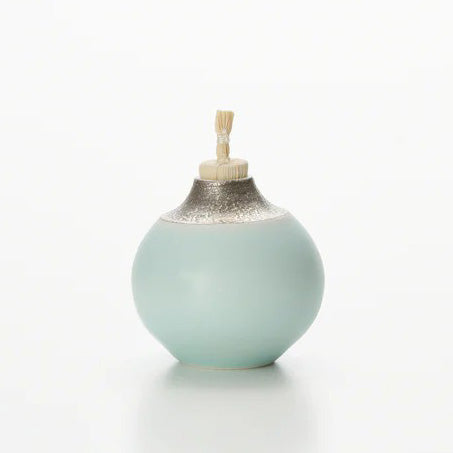
Blue and white porcelain with silver glaze, made by Kazuhiro Matsukawa (Φ6.1×h8.1)
-- "The tranquility of blue, the lingering feeling of silver. The beginning of adjusting the 'presence' in the palm of your hand."
Ⅰ Furidashi, a small "core of hospitality"
Among the tools used in the tea ceremony, the furidashi is an exceptionally small vessel that embodies the essence of hospitality. It holds dried sweets, especially granular sweets like konpeito and arieito, and is passed around quietly around the table, with guests taking only the amount they need. What is required for this is not just the storage capacity of the container, but dimensions that look beautiful in the hand when used, a center of gravity that does not clutter the space when placed, and a design that takes into account the sound and feel when handling the container .
This piece by Matsukawa Kazuhiro meets this demand, combining the transparent serenity of the pale blue porcelain with the subtle tension created by the silver glaze, elevating the piece from a "pet utensil" to a small core that helps to set the mood for the tea ceremony .
II. Blue-and-white porcelain: A color "clearer than white, softer than blue"
The blue-and-white porcelain glaze that encases the body is not a strong blue, but rather has a faint blue tinge that seems to glow from within as it comes into contact with light.While maintaining the brightness of white porcelain, it is not cold, but rather has a softness that is almost breathtaking - this "difficulty of blue-and-white porcelain" is precisely what Kazuhiro Matsukawa is at the forefront of.
In this particular piece, the rounded body of the vessel slowly rotates the light, and the highlight does not stand sharply in one spot, but rather glides across the surface. As a result, the entire vessel fluctuates subtly from "blue close to white" to "white close to blue" depending on the angle from which it is viewed, creating a quiet gradation of color . In the soft light of a tea room, this fluctuation appears even more delicate, deepening the vessel's presence as a tool.
III. Ginsai - Not "metallic light" but "particles of presence"
The upper part of this piece is decorated with silver glaze, creating a clear transition from the blue-and-white porcelain surface. However, the impression it gives is not a flashy metallic look. The silver glaze certainly sparkles when it catches the light, but at the same time, a fine pattern emerges on the surface, and it does not become a uniform mirror finish. This is important.
In other words, Matsukawa Kazuhiro does not apply the silver glaze as "decoration," but rather places it as a "lingering echo" that subtly changes the density of the air against the serenity of the pale blue porcelain . A tea ceremony is not a world of strong light. Rather, it is in a space with subdued light that the reflection of the silver glaze emerges as dots, particles, and a sense of presence. Therein lies the beauty of the vessel resonating with the setting.
IV. Shape: Rounded torso, firm shoulders, and "standing up"
The shape of the vessel gently bulges downwards and narrows naturally at the top. The rounded body creates a cute look, but at the same time, the center of gravity is low, making it stable to place. Furthermore, the tightness at the top prevents the whole piece from simply being "cute," ensuring its dignified utility .
Achieving both "softness" and "tightness" is one of the most difficult aspects of tea ceremony pottery. If it is only soft, the atmosphere becomes loose, but if it is only tight, it becomes suffocating. This piece is somewhere in between, positioned to allow for proper breathing. When you pick it up, your fingers naturally wrap around the body, and the neck guides your hand - the necessity of the form is understood through the gesture.
V. The “sound” and “space” of the lid (stopper)
This piece is equipped with a wooden stopper (with a string). This creates an experience that is not just visual. The act of removing and replacing the stopper involves slight resistance and release, which creates a "ma" (interval). In the tea ceremony, the ma is a time of silence, a space for movement, and a moment when the guests' breathing is synchronized.
The faint sound of one or two sugar candies being taken out, the dry thud of the candy rolling around inside the bowl, and the stillness of the pale blue porcelain that catches them all. On top of this, Ginsai adds a momentary "interjection" as a reaction to the light. The comprehensiveness of the tea ceremony, where hearing, touch and sight are united, is incorporated into this small bowl called Furidashi.
VI. Combinations - A dialogue between seasons and ingredients
In terms of seasons, pale blue porcelain strongly resonates with the white of winter and the pale light of early spring. On the other hand, silver glaze is reminiscent of moonlight, frost, or the sparkle of thin ice, evoking the quiet night air. It pairs extremely well with bamboo and wooden utensils, light-colored cloth, and white kaishi paper, and really shines in settings with a limited number of colors.
Furthermore, while it is also blue-and-white porcelain, unlike painted or ornate designs, this piece is made up of "white space." This is why, depending on the owner's aesthetic sense, it can be swung from cool and pure to soft and poetic. The vessel does not give a definitive conclusion, but rather blends in with the atmosphere of the dining room - this depth is the appeal of Kazuhiro Matsukawa's work.
VII Summary: A great silence dwells in a small tool
The "Blue and White Porcelain with Silver Lacquer" is a vessel for storing dried sweets, but it is also a "device of tranquility" to help regulate your breathing during the tea ceremony. The clarity of the blue and white porcelain, the lingering impression of the silver laquer, the firmness of the shape, and the movement of the stopper. All of these elements come together just right, and are completed quietly in the palm of your hand.
Small, yet with a definite presence. The props do not assert themselves, but rather clarify the atmosphere. I feel that this is the kind of elegance that Kazuhiro Matsukawa has given to this piece.
Biography
1977 Born in Kawachinagano, Osaka Prefecture
1998 Graduated from Nara College of Arts, Ceramic Art Course
2000 Graduated from Nara College of Arts
2001 Graduated from Kyoto Prefectural Pottery Technical College and studied under Takahiro Kondo
2006 Independent and opened a kiln in Kawachinagano City
Major solo exhibitions and exhibitions
2007 Kyoto Prefecture Fine Arts and Crafts New Artists Selection Exhibition (Kyoto Museum)
Two-person exhibition (Matsuzakaya Nagoya Art Gallery/Nagoya)
Solo exhibition (Kyoto Takashimaya Art and Craft Salon/Kyoto)
2008 Solo Exhibition (Campanule/Chiba)
Solo exhibition (Paramita Museum Small Gallery/Mie)
2009 Solo Exhibition (Gallery Espace/Nagoya)
2010 Solo Exhibition (Sapporo Mitsukoshi Art Gallery/Hokkaido)
Solo exhibition (Matsuzakaya Nagoya Art Gallery/Nagoya)
Solo exhibition (Alpark Tenmaya Art Gallery/Hiroshima)
2011 Solo Exhibition (Ceramics Gallery Furyo/Osaka) ('07)
2012 Solo Exhibition (Gallery Okumura/Tokyo) ('07 '09)
2013 Solo Exhibition (Lovely Hall 20th Anniversary Event/Osaka)
2014 Solo Exhibition (Tenmaya Hiroshima Hatchobori Art Gallery/Hiroshima) ('11)
2016 Solo Exhibition (Tenmaya Fukuyama Art Gallery/Hiroshima) ('08 '12)
Three-person exhibition (Hakata Hankyu Muse/Fukuoka)
2017 Solo Exhibition (Pinacotheca / Tokyo) ('14 '15)
Solo exhibition (Tenmaya Okayama Art Gallery/Okayama) ('08)
Solo exhibition (Atelier Hiro/Osaka)
2018 Solo Exhibition (Nihonbashi Mitsukoshi Main Store Art Gallery/Tokyo)
Solo exhibition (Takashimaya Osaka Gallery NEXT/Osaka) ('08 '11 '15)
2020 Solo Exhibition (Hana Asagi/Tokyo)
2021 Solo Exhibition (Gallery Tachibana/Nara) ('15 '17 '19)
2022 Two-person exhibition (Hana Asagi/Tokyo)
2023 Two-person exhibition (Atelier Hiro/Osaka)
2025 Two-person exhibition (Hana Asagi/Tokyo)
Solo exhibition (Midorigaoka Museum of Art/Nara)
Awards
36th Japan Traditional Crafts Kinki Exhibition (Osaka Prefecture Board of Education Award)
55th Japan Traditional Crafts Exhibition (Japan Crafts Association President's Award)
Public Collection
Midorigaoka Museum of Art
Share

-
[I will send it to you quickly and carefully]
We carefully package each product in a way that suits it best.
Also, delivery times vary depending on the piece (vessel, etc.).
Items that already come with a box will be shipped within 1-3 days of the order date.
For items that require a box to be made after your order, it will take approximately 30 days for production to be completed and then shipped.
In either case, once we have confirmed your order, we will contact you by email to inform you of the delivery date.
-
[Requests when purchasing pottery]
Even products that look the same may differ slightly in color, shape, size, etc.
The way the glaze is used, the power of the kiln, the firing method, the season, and the humidity also affect the appearance of the pottery.
Please understand the individuality of each piece of pottery and enjoy the unique warmth of handmade.