


Blue-and-white porcelain, silver color, Kazuhiro Matsukawa
Blue-and-white porcelain, silver color, Kazuhiro Matsukawa
Couldn't load pickup availability
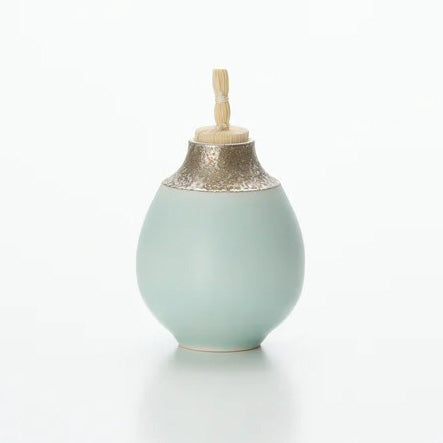
Blue and white porcelain with silver glaze, made by Kazuhiro Matsukawa (Φ5.4cm x H8.8cm)
-- "A 'quiet drop' that fits in the palm of your hand. Its clear blue-white color and hints of silver will beautifully enhance your manners at any table."
Ⅰ The tool of shori-dashi: A small token of gratitude for sharing
The furidashi is a small container for holding dried sweets such as konpeito and arieito, and for distributing small amounts to guests. Unlike larger confectionery containers that dominate the space with their extravagance, the furidashi is passed quietly from hand to hand, regulating the distance and breathing between guests - in that sense, it can be said to be the "smallest unit of courtesy" at a tea ceremony.
This piece has an easy-to-handle body of 5.4cm in diameter and a dignified rise of 8.8cm, which gives it both a sense of stability when handled by a guest (the one handling it) and beauty when handled by the host. The smaller the tool, the more likely a slight imperfection in its shape will manifest as a misstep in the host's movements, and Matsukawa Kazuhiro's sculpture is extremely neat in this respect.
II. The Scenery of Blue-and-White Porcelain: "Clearer than white, softer than blue" Transparency
The appeal of Kazuhiro Matsukawa's blue-and-white porcelain lies in the purity of the white porcelain and the subtle blue shades of the glaze that are layered on top of it. From the photograph, it can be seen that the light reflects evenly across the surface, and that the glaze layer gently envelops the vessel as a thin film.
Unlike celadon, which stands out with its strong color, pale blue porcelain is a type of beauty in which the "blue" color emerges only when it is exposed to light. In other words, its appearance changes depending on the viewer's position, the time of day, and the light level in the room. This fluctuation is a quality that is extremely compatible with the world of tea, where utensils "function" as part of the setting.
III. Ginsai: "Another Light" - Like moonlight, it dwells modestly
The silver decoration around the rim does not project a brilliant light like gold, but rather reflects it quietly like moonlight, leaving only a trace.
What's even more striking about this piece is that the silver glaze is not applied uniformly as a surface, but appears as a landscape that includes fine grains. If the silver were too uniform, the craft item would lean more towards decorativeness, but this silver glaze does not detract from the clarity of the pale blue porcelain, and instead adds a level of "cold light" to balance the warmth of the piece.
The pale blue body and silver edging give the entire piece a tranquil rhythm - the ingenious design is a highlight.
IV. Key points of the design: the teardrop-shaped body and the tension around the mouth
The body has a soft tension reminiscent of a teardrop (the bulge just before a drop falls). The lower part has ample volume, while the neck is smoothly tapered and leads upward, creating a "poetic tension" in the standing pose.
In addition, the small opening prevents the sweets from accidentally spilling and ensures a smooth release when shaken. The strength of Matsukawa Kazuhiro's work lies in the fact that the practical design is consistent with the beauty of the shape.
V. The movement of the lid and stopper - A quiet contrast created by different materials
The piece has a wooden lid at the top, adding a touch of wood's warmth to the lineage of the "cold light" of the pale blue porcelain and silver glaze.
At tea ceremonies, the combination of different materials is an important clue to conveying the season and taste. For example, at a winter gathering, the cool light of silver glaze evokes frost and the moon, while the wooden base echoes the fire in the hearth and the warmth of people. At the beginning of spring, the pale blue glaze evokes mist and morning moisture, while the pale color of the wooden cork brings to mind the signs of budding.
This "slight difference in materials" adds depth to the story of the tool.
VI. Combination Suggestions - As a Modest Main Player
Sweets : It goes well with light-colored sweets such as konpeito, arietsu, and light snow jelly. The silver color does not interfere with the color of the sweets, but rather enhances them elegantly.
The seasonal feel of the seat : Ginsai = moon, frost, thin ice, pale blue porcelain = water, mist, distant view. It looks particularly beautiful from autumn to early spring, but in summer it has a strong effect as a symbol of "coolness."
Matching tools : By using just one piece of metal, such as a silver tea scoop or a tin teapot, the overall look will be more refined without being overly ornate.
VII Conclusion: A clear idea residing in a small vessel
The furidashi is a small, inconspicuous utensil. However, at a tea ceremony, its smallness is what determines its elegance. The weight when a guest picks it up, the ridges that touch their fingertips, the smoothness of the gesture of handling the lid—these are all things that convey the host's consideration.
This work by Kazuhiro Matsukawa, "Blue and White Porcelain with Silver Glaze," is a highly refined piece that combines the clarity of the blue and white porcelain with the quiet light of the silver glaze, and is further balanced by the temperature of the wooden stopper. We hope you will enjoy the sensation of "a tool working quietly in the palm of your hand."
Biography
1977 Born in Kawachinagano, Osaka Prefecture
1998 Graduated from Nara College of Arts, Ceramic Art Course
2000 Graduated from Nara College of Arts
2001 Graduated from Kyoto Prefectural Pottery Technical College and studied under Takahiro Kondo
2006 Independent and opened a kiln in Kawachinagano City
Major solo exhibitions and exhibitions
2007 Kyoto Prefecture Fine Arts and Crafts New Artists Selection Exhibition (Kyoto Museum)
Two-person exhibition (Matsuzakaya Nagoya Art Gallery/Nagoya)
Solo exhibition (Kyoto Takashimaya Art and Craft Salon/Kyoto)
2008 Solo Exhibition (Campanule/Chiba)
Solo exhibition (Paramita Museum Small Gallery/Mie)
2009 Solo Exhibition (Gallery Espace/Nagoya)
2010 Solo Exhibition (Sapporo Mitsukoshi Art Gallery/Hokkaido)
Solo exhibition (Matsuzakaya Nagoya Art Gallery/Nagoya)
Solo exhibition (Alpark Tenmaya Art Gallery/Hiroshima)
2011 Solo Exhibition (Ceramics Gallery Furyo/Osaka) ('07)
2012 Solo Exhibition (Gallery Okumura/Tokyo) ('07 '09)
2013 Solo Exhibition (Lovely Hall 20th Anniversary Event/Osaka)
2014 Solo Exhibition (Tenmaya Hiroshima Hatchobori Art Gallery/Hiroshima) ('11)
2016 Solo Exhibition (Tenmaya Fukuyama Art Gallery/Hiroshima) ('08 '12)
Three-person exhibition (Hakata Hankyu Muse/Fukuoka)
2017 Solo Exhibition (Pinacotheca / Tokyo) ('14 '15)
Solo exhibition (Tenmaya Okayama Art Gallery/Okayama) ('08)
Solo exhibition (Atelier Hiro/Osaka)
2018 Solo Exhibition (Nihonbashi Mitsukoshi Main Store Art Gallery/Tokyo)
Solo exhibition (Takashimaya Osaka Gallery NEXT/Osaka) ('08 '11 '15)
2020 Solo Exhibition (Hana Asagi/Tokyo)
2021 Solo Exhibition (Gallery Tachibana/Nara) ('15 '17 '19)
2022 Two-person exhibition (Hana Asagi/Tokyo)
2023 Two-person exhibition (Atelier Hiro/Osaka)
2025 Two-person exhibition (Hana Asagi/Tokyo)
Solo exhibition (Midorigaoka Museum of Art/Nara)
Awards
36th Japan Traditional Crafts Kinki Exhibition (Osaka Prefecture Board of Education Award)
55th Japan Traditional Crafts Exhibition (Japan Crafts Association President's Award)
Public Collection
Midorigaoka Museum of Art
Share

-
[I will send it to you quickly and carefully]
We carefully package each product in a way that suits it best.
Also, delivery times vary depending on the piece (vessel, etc.).
Items that already come with a box will be shipped within 1-3 days of the order date.
For items that require a box to be made after your order, it will take approximately 30 days for production to be completed and then shipped.
In either case, once we have confirmed your order, we will contact you by email to inform you of the delivery date.
-
[Requests when purchasing pottery]
Even products that look the same may differ slightly in color, shape, size, etc.
The way the glaze is used, the power of the kiln, the firing method, the season, and the humidity also affect the appearance of the pottery.
Please understand the individuality of each piece of pottery and enjoy the unique warmth of handmade.