


Blue-and-white porcelain silver-sawn round gourd Kazuhiro Matsukawa
Blue-and-white porcelain silver-sawn round gourd Kazuhiro Matsukawa
Couldn't load pickup availability
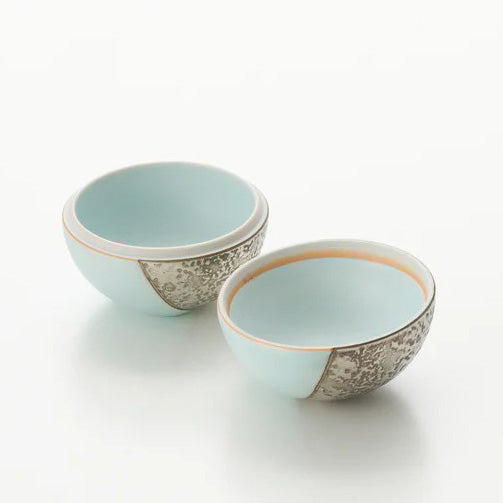
Blue-and-white porcelain silver-sailed round gourd by Kazuhiro Matsukawa (Φ6.6×h6.3)
-- "A silver moon nestles against a quiet blue. The act of "closing the lid" in the palm of your hand becomes a ritual."
I. The vessel known as a goshi - dignity born from storage
A gosu is not just a container for storing things. It is a tool that supports a moment in time, including the "presence" before opening the lid, the "breath" when closing the lid, and the "aftertaste" that lingers after closing.
This piece, "Blue and White Porcelain Silver-Decorated Round Bowl," embodies the essence of a bowl - the beauty of "concealment" - in its small dimensions of 6.6cm in diameter and 6.3cm in height. When you pick it up, the rounded outline fits into your palm, and your eye is naturally drawn to the center. There, you will see the contrast between the clear surface of the blue and white porcelain and the dull light of the silver decoration.
II. The clarity of pale blue porcelain: a "neutral light" that is neither white nor blue
The appeal of pale blue porcelain is that it has the cleanliness of white porcelain, but also a glaze with a slight bluish tinge that includes soft shadows.It is not a strong white, but rather a "pale light" that contains a quiet coolness, so it delicately reflects the colors of the surrounding air and lighting.
The surface of this pale blue porcelain is smooth yet not too hard, giving it a slightly cloudy appearance like light snow. When light hits it, the gloss is not too pronounced, but rather acts as a "sinking transparency" that gives the entire vessel depth. It harmonizes with any background - white tea ceremony paper, black lacquer, wooden tray - while maintaining the tranquil presence that is unique to pale blue porcelain.
III. The Expression of Ginsai: Metal as a Presence, Not a Sparkle
Ginsai is not as flashy and bold as gold, but rather, like moonlight, it is a modest decoration that certainly changes the quality of the space.
The silver glaze applied to this piece is not a uniform metallic finish, but appears as a dull glow, containing slight irregularities and scenery. Depending on the angle, it may reflect brightly at one moment, or sink like ash at another. This fluctuation gives the piece a "quiet drama."
Ginsai is also an expression that changes easily over time. Depending on how it is handled and the environment, it can change to a more subdued tone and blend into the surface of the vessel. This includes the appearance of aging, and it is this beauty that "develops with use."
IV. The idea of round shapes: Forms that align the palm, gaze, and gestures
Unlike ceramic boxes with corners, round containers have a design that does not have a directional orientation, making it easy for the eye to be drawn to one point.No matter where you look at it, it is the "front," so it does not create too much tension in the space where it is placed, yet it has a central presence.
The 6.6cm diameter is just right for turning it in your hand and looking at it, and the gesture of fitting the lid together is also beautiful. The slight "step of the lid" and "line of the rim" are barely noticeable from the outside, but when you touch them you can feel a definite boundary - this design supports the dignity of the bowl.
V. What to Offer: Incense, Sweets, and Small Treasures
Because a bowl can be used for any purpose, it can reflect the owner's aesthetic sense. For example, the following uses look beautiful:
As a storage container for incense : For storing kneaded incense, pieces of incense wood, and small incense-smelling tools. The moment you open the lid, the fragrance rises, echoing the tranquility of the container.
As a tea ceremony accessory : A small amount of dry sweets such as konpeito (candy) or kohakuto (amber sugar). The pale blue of the blue-and-white porcelain does not interfere with the color of the sweets, and the silver glaze adds a special touch.
As a case for jewelry and small items : rings, earrings, cufflinks, or small seals and charms. The act of "keeping away" your important items without showing them is itself an act of organizing your daily life.
VI. The beauty of combinations: White, silver, and pale blue create a "modern tranquility"
This piece has the feel of a traditional tea ceremony implement, but its minimalist design allows it to be placed naturally in a modern space.
Even in an inorganic environment such as a room with white walls, glass and metal furniture, and a concrete floor, the soft warmth of the pale blue porcelain shines through, and the silver glaze picks up the light of the space and breathes quietly. Conversely, the clarity of the pale blue porcelain is further accentuated when combined with objects with a strong texture, such as a shelf made of old wood, a lacquerware tray, or a bamboo vase.
Modern within "Japanese" and "space" within modern. The strength of this small Goko is that it achieves both.
Ⅶ Important points for use and handling (Ginsai)
Ginsai is a very delicate expression, so we recommend the following to ensure it lasts beautifully. Do not rub with strong abrasives or hard sponges. Avoid immersing in water for long periods of time, and wipe off any moisture with a soft cloth after use. Avoid storing for long periods in direct sunlight or in a high-humidity environment. You can also enjoy the transformation of the ginsai into a more subdued appearance as part of the vessel's scenery.
VIII Summary: A "small vessel" calms time
The "Blue and White Porcelain Silver-Painted Round Bowl" is a small vessel that fits in the palm of your hand. However, every time you open or close the lid, the atmosphere in the room becomes more balanced and your mind becomes more calm - it is this size that makes it a "vessel of time."
The clear surface of the pale blue porcelain gently catches the light, and the silver glittering gently sways like the moon. For those who want to incorporate a certain level of beauty into their daily lives, we offer the unique shapes and wordless poetry of Kazuhiro Matsukawa.
Biography
1977 Born in Kawachinagano, Osaka Prefecture
1998 Graduated from Nara College of Arts, Ceramic Art Course
2000 Graduated from Nara College of Arts
2001 Graduated from Kyoto Prefectural Pottery Technical College and studied under Takahiro Kondo
2006 Independent and opened a kiln in Kawachinagano City
Major solo exhibitions and exhibitions
2007 Kyoto Prefecture Fine Arts and Crafts New Artists Selection Exhibition (Kyoto Museum)
Two-person exhibition (Matsuzakaya Nagoya Art Gallery/Nagoya)
Solo exhibition (Kyoto Takashimaya Art and Craft Salon/Kyoto)
2008 Solo Exhibition (Campanule/Chiba)
Solo exhibition (Paramita Museum Small Gallery/Mie)
2009 Solo Exhibition (Gallery Espace/Nagoya)
2010 Solo Exhibition (Sapporo Mitsukoshi Art Gallery/Hokkaido)
Solo exhibition (Matsuzakaya Nagoya Art Gallery/Nagoya)
Solo exhibition (Alpark Tenmaya Art Gallery/Hiroshima)
2011 Solo Exhibition (Ceramics Gallery Furyo/Osaka) ('07)
2012 Solo Exhibition (Gallery Okumura/Tokyo) ('07 '09)
2013 Solo Exhibition (Lovely Hall 20th Anniversary Event/Osaka)
2014 Solo Exhibition (Tenmaya Hiroshima Hatchobori Art Gallery/Hiroshima) ('11)
2016 Solo Exhibition (Tenmaya Fukuyama Art Gallery/Hiroshima) ('08 '12)
Three-person exhibition (Hakata Hankyu Muse/Fukuoka)
2017 Solo Exhibition (Pinacotheca / Tokyo) ('14 '15)
Solo exhibition (Tenmaya Okayama Art Gallery/Okayama) ('08)
Solo exhibition (Atelier Hiro/Osaka)
2018 Solo Exhibition (Nihonbashi Mitsukoshi Main Store Art Gallery/Tokyo)
Solo exhibition (Takashimaya Osaka Gallery NEXT/Osaka) ('08 '11 '15)
2020 Solo Exhibition (Hana Asagi/Tokyo)
2021 Solo Exhibition (Gallery Tachibana/Nara) ('15 '17 '19)
2022 Two-person exhibition (Hana Asagi/Tokyo)
2023 Two-person exhibition (Atelier Hiro/Osaka)
2025 Two-person exhibition (Hana Asagi/Tokyo)
Solo exhibition (Midorigaoka Museum of Art/Nara)
Awards
36th Japan Traditional Crafts Kinki Exhibition (Osaka Prefecture Board of Education Award)
55th Japan Traditional Crafts Exhibition (Japan Crafts Association President's Award)
Public Collection
Midorigaoka Museum of Art
Share


-
[I will send it to you quickly and carefully]
We carefully package each product in a way that suits it best.
Also, delivery times vary depending on the piece (vessel, etc.).
Items that already come with a box will be shipped within 1-3 days of the order date.
For items that require a box to be made after your order, it will take approximately 30 days for production to be completed and then shipped.
In either case, once we have confirmed your order, we will contact you by email to inform you of the delivery date.
-
[Requests when purchasing pottery]
Even products that look the same may differ slightly in color, shape, size, etc.
The way the glaze is used, the power of the kiln, the firing method, the season, and the humidity also affect the appearance of the pottery.
Please understand the individuality of each piece of pottery and enjoy the unique warmth of handmade.