


Blue and white porcelain silver-colored pottery Kazuhiro Matsukawa
Blue and white porcelain silver-colored pottery Kazuhiro Matsukawa
Couldn't load pickup availability
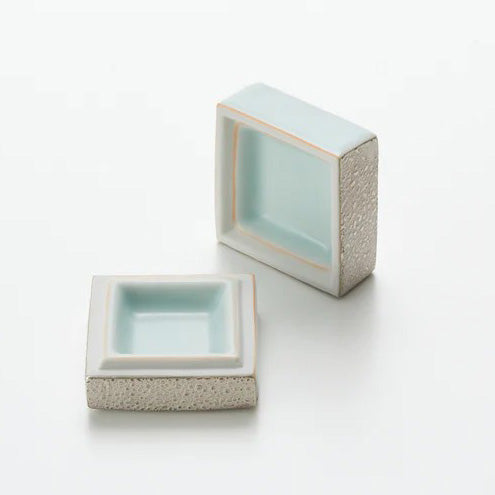
Blue and white porcelain silver-glazed ceramic box by Kazuhiro Matsukawa (W: 4.5cm D: 4.5cm H: 2.9cm)
--"Silver falls quietly in the stillness of pale blue. A small alcove that fits in the palm of your hand."
Ⅰ The ceramic box: a “scenery for storage”
A ceramic box is not just a container for storing things. The act of fitting the lid and gently opening it is a tool that regulates the density of space and the speed of the mind. Similar to an incense container, but with a stronger meaning of "storage," the toubako's meaning is enhanced by the imagination of what will be placed inside, which further enriches the expression of the container .
This piece has extremely small dimensions of W4.5 x D4.5 x H2.9, yet it has the power to bring a sense of tranquility to any space the moment it is placed. Its small size, which fits in the palm of your hand, is actually a powerful expression of its condensed power. The more you look at it, the more the "universe of small things" beloved by the tea ceremony emerges.
II. The Charm of Blue-and-White Porcelain: Clearer than White, Softer than Blue
2-1 The "breathing" of the color of blue-and-white porcelain
Blue-and-white porcelain is a world based on the clarity of white porcelain, with hints of very pale blue. It is not a strong color, but a blue that fluctuates like temperature depending on how the light hits it. The light blue surface seen in the photo is by no means assertive, but serves as a subtle difference that deepens the tranquility.
The light glides smoothly along the ridges of the surface, and the shadows that gather at the corners create a sense of depth that exceeds the vessel's small size. The pale color of the pale blue porcelain sharpens the viewer's senses because it provides little information.
2-2 Speaking on two levels: The strength of minimalism
The form of this piece is almost devoid of decoration. However, it is not that there is nothing there; rather, the precision of the surface itself is the design . The square form immediately reveals even the slightest distortion or irregularity in thickness. Despite these strict conditions, Matsukawa Kazuhiro has managed to achieve a tranquil outline. The more minimalist a piece is, the more the breath of the maker is directly reflected in the vessel - this piece is a good example of this.
Ⅲ Silver-colored scenery - the light falling is cut diagonally
3-1 Silver is not a mirror, but like snow and frost
The silver glaze on one corner of the lid is not flashy or reflective. It has fine grains that catch the light in spots and scatter it softly, giving it a texture reminiscent of frost pillars or thin snow .
This grainy surface contrasts with the calm surface of the pale blue porcelain, and the vessel itself is filled with two different weather conditions: one is the calm surface of water, the other is a cold sparkle. The atmosphere of the seasons intersects on this small box.
3-2 Diagonal composition: Adding tension to stillness
What separates Ginsai and Seihakuji is the clear diagonal line. By adding a diagonal line to a square lid, the eye naturally runs from corner to corner, giving the vessel a sense of movement even though it is small.
Yet strangely, this movement is not noisy. Rather, it creates tension in the silence , tightening the atmosphere when the box is placed there. Just as a row of hanging scrolls at a tea ceremony straightens the air, this work tidies up the space with the "sensation of line."
IV. Design of the lid and body: To ensure the beautiful opening and closing action
4-1 Neat shadows created by steps and ridges
There is a thin, linear step at the boundary between the body and the lid. The shadow cast there sharply accentuates the contours of the vessel, creating a "complete landscape" even when the vessel is closed.
Furthermore, the sides of the piece show a quiet texture that differs from the density of the silver glaze. Rather than a smooth, uniform finish, a subtle fluctuation is left, allowing the warmth of the human hand to overlap with the coolness and purity of the blue-and-white porcelain.
4-2 Light blue interior: A space for "purifying" stored items
When you remove the lid, the inside is enveloped in a pale blue layer. This is important. If the outside is the "front" that sets the atmosphere, then the inside is the "back" that receives the presence of what is contained within.
You can store incense, small ornaments, or even choose to leave it empty. Empty is beautiful—a ceramic box can also be a vessel for storing emptiness .
V. Combination Suggestions: A small box for the tea ceremony season
This piece is well suited to the cold, transparent seasonal sensations of spring's light snow, summer's thin ice, autumn's clear skies, and winter's frost. The silver glaze acts as the sparkle of moonlight and frost, while the pale blue porcelain supports the scene with the stillness of water and air.
If you place it on a shelf, placing it on a black or dark shelf will make it stand out, and combining it with a white paper box or white cloth will enhance its purity. Because it is small, it absorbs the colors of its surroundings and adds elegance to the space - that is the strength of this ceramic box.
summary
The blue-and-white porcelain box with silver glaze is a tranquil microcosm that condenses the clarity of blue-and-white porcelain and the cool brilliance of silver glaze into a palm-sized piece. The diagonally changing surface of the box is minimal yet possesses a clear poetic sentiment, transforming even the act of opening the lid into a "scenery."
More than just a container for storage, it is also a container for organizing the space and calming the mind.It is an excellent piece that brings a certain sense of space and elegance to both everyday life and the tea ceremony.
Biography
1977 Born in Kawachinagano, Osaka Prefecture
1998 Graduated from Nara College of Arts, Ceramic Art Course
2000 Graduated from Nara College of Arts
2001 Graduated from Kyoto Prefectural Pottery Technical College and studied under Takahiro Kondo
2006 Independent and opened a kiln in Kawachinagano City
Major solo exhibitions and exhibitions
2007 Kyoto Prefecture Fine Arts and Crafts New Artists Selection Exhibition (Kyoto Museum)
Two-person exhibition (Matsuzakaya Nagoya Art Gallery/Nagoya)
Solo exhibition (Kyoto Takashimaya Art and Craft Salon/Kyoto)
2008 Solo Exhibition (Campanule/Chiba)
Solo exhibition (Paramita Museum Small Gallery/Mie)
2009 Solo Exhibition (Gallery Espace/Nagoya)
2010 Solo Exhibition (Sapporo Mitsukoshi Art Gallery/Hokkaido)
Solo exhibition (Matsuzakaya Nagoya Art Gallery/Nagoya)
Solo exhibition (Alpark Tenmaya Art Gallery/Hiroshima)
2011 Solo Exhibition (Ceramics Gallery Furyo/Osaka) ('07)
2012 Solo Exhibition (Gallery Okumura/Tokyo) ('07 '09)
2013 Solo Exhibition (Lovely Hall 20th Anniversary Event/Osaka)
2014 Solo Exhibition (Tenmaya Hiroshima Hatchobori Art Gallery/Hiroshima) ('11)
2016 Solo Exhibition (Tenmaya Fukuyama Art Gallery/Hiroshima) ('08 '12)
Three-person exhibition (Hakata Hankyu Muse/Fukuoka)
2017 Solo Exhibition (Pinacotheca / Tokyo) ('14 '15)
Solo exhibition (Tenmaya Okayama Art Gallery/Okayama) ('08)
Solo exhibition (Atelier Hiro/Osaka)
2018 Solo Exhibition (Nihonbashi Mitsukoshi Main Store Art Gallery/Tokyo)
Solo exhibition (Takashimaya Osaka Gallery NEXT/Osaka) ('08 '11 '15)
2020 Solo Exhibition (Hana Asagi/Tokyo)
2021 Solo Exhibition (Gallery Tachibana/Nara) ('15 '17 '19)
2022 Two-person exhibition (Hana Asagi/Tokyo)
2023 Two-person exhibition (Atelier Hiro/Osaka)
2025 Two-person exhibition (Hana Asagi/Tokyo)
Solo exhibition (Midorigaoka Museum of Art/Nara)
Awards
36th Japan Traditional Crafts Kinki Exhibition (Osaka Prefecture Board of Education Award)
55th Japan Traditional Crafts Exhibition (Japan Crafts Association President's Award)
Public Collection
Midorigaoka Museum of Art
Share


-
[I will send it to you quickly and carefully]
We carefully package each product in a way that suits it best.
Also, delivery times vary depending on the piece (vessel, etc.).
Items that already come with a box will be shipped within 1-3 days of the order date.
For items that require a box to be made after your order, it will take approximately 30 days for production to be completed and then shipped.
In either case, once we have confirmed your order, we will contact you by email to inform you of the delivery date.
-
[Requests when purchasing pottery]
Even products that look the same may differ slightly in color, shape, size, etc.
The way the glaze is used, the power of the kiln, the firing method, the season, and the humidity also affect the appearance of the pottery.
Please understand the individuality of each piece of pottery and enjoy the unique warmth of handmade.