


Blue and white porcelain silver saiko Kazuhiro Matsukawa
Blue and white porcelain silver saiko Kazuhiro Matsukawa
Couldn't load pickup availability
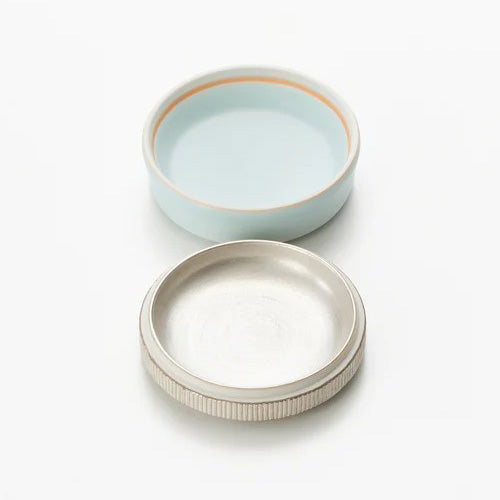
Blue and white porcelain silver-colored bowl by Kazuhiro Matsukawa (Φ7.5×h3.5)
--"The silver of the moonlight sinks softly into the circle of pale water."
Ⅰ The "small universe" of Goko: The act of opening the lid sets the stage
Unlike incense containers or sweets dishes, a gosu is not a tool whose value is determined solely by what is placed inside. Rather, the fleeting act of removing the lid creates a moment of pause in the atmosphere of the tea ceremony, allowing the guests' gazes and breathing to align for a moment - it is a vessel for this purpose.
This piece, "Blue and White Porcelain Silver-Colored Bowl," fits in the palm of your hand and neatly embodies all the qualities required of a bowl ( easy opening and closing, a snug fit for the lid, and the dignity of the vessel ).
A round shape, without any sharp edges, can easily lean towards "sweetness," but this is not the case with Kazuhiro Matsukawa's Aiko. The rounded edges are plump, yet the outlines are clear and somehow dignified. The coexistence of softness and tension is the primary appeal of this piece.
II. The color of pale blue porcelain: quieter than "white" and paler than blue
The pale blue porcelain body is not captivating with its strong color, but rather has a pale, watery color that brightens from within as it receives more light. It has the cleanliness of white porcelain, but is not cold. It has a hint of celadon, but is not too assertive.
This "beauty in between" may appear simply pale in a photograph, but in person it is clearly different. With each change in environment—the soft light of a room, the slanting evening light, the dim light of a tea room—the blue hidden deep within the texture changes its expression ever so slightly.
The surface of the vessel is smooth, but not completely glassy, and one can sense a slight breath of life remaining. When your fingertips touch it, they don't just slide, but settle with a gentle resistance . This "tactile design" is especially effective because the bowl is a vessel that is held in the hand.
III. The Presence of Ginsai: A Metal that Speaks Not Through Its Shine, But Through Its Silence
The silver glaze in this work does not have the so-called flashy metallic sparkle. Rather, it absorbs light, gives it back, and then sinks back down again - in this cycle, it gives off a dull reflection like moonlight .
Silver is more delicate than gold and is easily affected by its environment. That's why, while silver glaze can easily create a sense of luxury, there is also the risk that the entire piece could look vulgar if not done properly. However, Matsukawa Kazuhiro's silver glaze does not destroy the pure atmosphere of the pale blue porcelain, but rather tightens it up.
If the pale blue porcelain represents "water," then the silver glaze represents the moon. When the moon is reflected on the water's surface, the water appears deeper and the moon appears more tranquil. Each complements the other, and neither takes center stage - this restraint determines the high quality of this bowl.
IV. Precision of form: The core of the beauty of a goko is that it "fits" together
The beauty of a bowl lies in the fact that it "fits" perfectly. If the boundary between the lid and the body is not perfect, the bowl will lose its tension and will not function as a "tool" no matter how beautiful the interior is.
This piece features a smooth, even join between the lid and the body, giving the appearance of a single piece, while still providing a secure grip for opening and closing. This is where the sincerity of Matsukawa Kazuhiro's design is evident.
The height is neither too low nor too high, and the proportions are such that the eye naturally falls from above . It does not have an excessive presence on the table, but it does not get lost either. It is a very easy-to-use size for tea ceremonies and table coordination.
V. Imagine its uses: as an incense container, a sweets container, or a memento container
The first thing that comes to mind when thinking of uses for this incense holder is its use. The smaller the incense, the denser it becomes, whether it's kneaded incense, incense seals, or small incense for listening to incense. The serenity of the pale blue porcelain does not disturb the scent of the incense, and the silver glaze enhances the incense's "stature."
It would also be beautiful as a small sweets dish to hold a small amount of dried sweets at a thin tea ceremony. The silver-colored surface prevents white or light-colored dried sweets from sinking into the air, creating a visual focal point.
Furthermore, the goko is also a container for storing things. A ring, a piece of fragrant wood, a pebble picked up on a trip - you can quietly store away those precious things in your life that are hard to put into words. Once the lid is closed, no one can see what is inside. This anonymity makes the contents even more precious.
This bowl is also a perfect container for storing such personal memories.
VI. How the seasons suit each other: the light haze of spring, the moon of autumn, and the clear air of winter
Although blue-and-white porcelain seems to be suitable for any season, it actually reflects the atmosphere of each season.
Spring: The light dissolves into a soft, hazy light, and the vessel appears to be "quietly warming."
Autumn: The silver color evokes moonlight, and the vessel evokes the feeling of long nights.
Winter: The clearer the air, the brighter the pale blue porcelain becomes, and the silence of the silver glaze becomes even more apparent.
Although it can be used all year round, its appearance changes with each season. This is the strength of Kazuhiro Matsukawa's blue-and-white porcelain.
Ⅶ Important points for handling - To develop beautiful Ginsai
The color tone of Ginsai may change depending on the environment (the so-called aged appearance). This is not a defect, but rather a way of life for the silver material.
For safe storage, avoid high temperatures, humidity, and direct sunlight, and if possible, avoid placing it in close contact with other metal products. For care, wipe it dry with a soft cloth and avoid using strong abrasives.
Rather than fixating on the "initial glow," enjoy the silvery scenery as it quietly grows -- this attitude brings out the most charm of this Goko.
Summary: Small but classy
The pale blue of the pale blue porcelain and the sunken moonlight of the silver glaze. The gentleness of the round shape and the strict precision of the bowl.
This piece is not meant to be a show piece, but rather to enhance the atmosphere, enhance one's manners, and increase serenity . Though it is a small piece, it has a certain dignity. For this reason, the longer you keep it, the more its value will grow.
Biography
1977 Born in Kawachinagano, Osaka Prefecture
1998 Graduated from Nara College of Arts, Ceramic Art Course
2000 Graduated from Nara College of Arts
2001 Graduated from Kyoto Prefectural Pottery Technical College and studied under Takahiro Kondo
2006 Independent and opened a kiln in Kawachinagano City
Major solo exhibitions and exhibitions
2007 Kyoto Prefecture Fine Arts and Crafts New Artists Selection Exhibition (Kyoto Museum)
Two-person exhibition (Matsuzakaya Nagoya Art Gallery/Nagoya)
Solo exhibition (Kyoto Takashimaya Art and Craft Salon/Kyoto)
2008 Solo Exhibition (Campanule/Chiba)
Solo exhibition (Paramita Museum Small Gallery/Mie)
2009 Solo Exhibition (Gallery Espace/Nagoya)
2010 Solo Exhibition (Sapporo Mitsukoshi Art Gallery/Hokkaido)
Solo exhibition (Matsuzakaya Nagoya Art Gallery/Nagoya)
Solo exhibition (Alpark Tenmaya Art Gallery/Hiroshima)
2011 Solo Exhibition (Ceramics Gallery Furyo/Osaka) ('07)
2012 Solo Exhibition (Gallery Okumura/Tokyo) ('07 '09)
2013 Solo Exhibition (Lovely Hall 20th Anniversary Event/Osaka)
2014 Solo Exhibition (Tenmaya Hiroshima Hatchobori Art Gallery/Hiroshima) ('11)
2016 Solo Exhibition (Tenmaya Fukuyama Art Gallery/Hiroshima) ('08 '12)
Three-person exhibition (Hakata Hankyu Muse/Fukuoka)
2017 Solo Exhibition (Pinacotheca / Tokyo) ('14 '15)
Solo exhibition (Tenmaya Okayama Art Gallery/Okayama) ('08)
Solo exhibition (Atelier Hiro/Osaka)
2018 Solo Exhibition (Nihonbashi Mitsukoshi Main Store Art Gallery/Tokyo)
Solo exhibition (Takashimaya Osaka Gallery NEXT/Osaka) ('08 '11 '15)
2020 Solo Exhibition (Hana Asagi/Tokyo)
2021 Solo Exhibition (Gallery Tachibana/Nara) ('15 '17 '19)
2022 Two-person exhibition (Hana Asagi/Tokyo)
2023 Two-person exhibition (Atelier Hiro/Osaka)
2025 Two-person exhibition (Hana Asagi/Tokyo)
Solo exhibition (Midorigaoka Museum of Art/Nara)
Awards
36th Japan Traditional Crafts Kinki Exhibition (Osaka Prefecture Board of Education Award)
55th Japan Traditional Crafts Exhibition (Japan Crafts Association President's Award)
Public Collection
Midorigaoka Museum of Art
Share

-
[I will send it to you quickly and carefully]
We carefully package each product in a way that suits it best.
Also, delivery times vary depending on the piece (vessel, etc.).
Items that already come with a box will be shipped within 1-3 days of the order date.
For items that require a box to be made after your order, it will take approximately 30 days for production to be completed and then shipped.
In either case, once we have confirmed your order, we will contact you by email to inform you of the delivery date.
-
[Requests when purchasing pottery]
Even products that look the same may differ slightly in color, shape, size, etc.
The way the glaze is used, the power of the kiln, the firing method, the season, and the humidity also affect the appearance of the pottery.
Please understand the individuality of each piece of pottery and enjoy the unique warmth of handmade.